


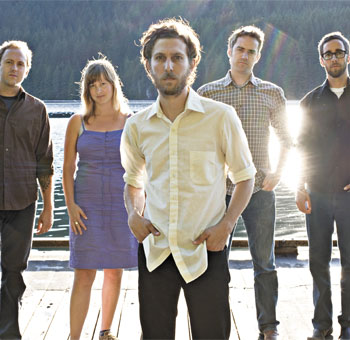

ORDERING A HOT toddy to take the chill off a blustery winter afternoon, Tony Dekker, of Great Lake Swimmers, settles into the leather banquette at the Inter Steer restaurant in his Roncesvalles neighbourhood.
He calls the area home but has spent scant time here in the last year. Such is the hectic touring life of Canada’s quietest rock star.
Since releasing their stunning fourth album, Lost Channels, in early 2009, Dekker and crew have toured and toured some more with major forays in Europe and China in support of the band’s most ambitious release to date.
The record, nominated by music critics across the country for the 2009 Polaris Music Prize, has a fuller sound than previous efforts with contributions from a more stable musical collective adding texture and depth to Dekker’s poignant, rich lyrics and haunting vocals.
Dekker and company recorded a stripped down version of the album at a local legion hall. The Legion Sessions has since taken on a life of its own online, and a new album chronicling the intimate event should be available next month.
“It is this classic old legion with lots of wood, trophies, photos of old prime ministers and the Queen, Christmas lights, streamers from whatever last event was held there and this little bar in the basement,”Dekker explains.“It is just this iconic Canadian place.”
Place: a word that goes far in defining Dekker’s songwriting, as well as his recording preferences and his philosophical approach to life.
Great Lake Swimmers make a habit of recording in unique locations — an abandoned grain silo for the first album, an old church, Ward’s Island for their third album, Ongiara.
For Lost Channels, Dekker and company recorded in several locations throughout The 1000 Islands, including the well-documented session in Singer Castle.
It is a search for the perfect acoustics, but for Dekker there is more to it. The location is like a new band member recruited for a particular album.
“There is something intangible,” says Dekker. “The feel of a place, a charge or an energy. It becomes an important part of the recording process.The rooms become almost like a background colour to a painter or another layer of sound on a recording.”
Growing up on a farm in the Niagara region near Wainfleet, Ont., Dekker was infused with a sense of place early in life.
“Coming from a rural community, especially a farm, you develop a special relationship with, say, weather patterns and seasonal changes, and that becomes important to you,” Dekker explains. “I was really infused with that at a young age, and that gave me some sort of perspective on these things that really matter to me now, maybe even on a different level.”
Moving to the city of London to attend university, Dekker was able to find his musical voice as a solo artist and a member of the band Two Minute Miracles in relative anonymity, but playing his style of music, solo, in a bar had its own challenges.
“I must have played every dive in Canada.” Dekker laughs. “It was a trial by fire for sure, just plugging in and playing is not an easy thing to do.”
According to Dekker, the difficulties of being heard above the din of a bar was partly the reason Dekker formed a band.
“It was easier to make a statement with a band,” he says.
For many years, that band consisted of a rotating cast of musicians that accompanied Dekker in the studio or on tour.
But, over the last couple years, the group has solidified, and as a result, the music has grown. “I think we’re in a really good place creatively now,” says Dekker, just days before leaving to play the Vancouver Olympics. “As a band, as a ‘thing,’we are really hitting our stride.”
Great Lake Swimmers play the Royal York Hotel on M a r c h 13.
