
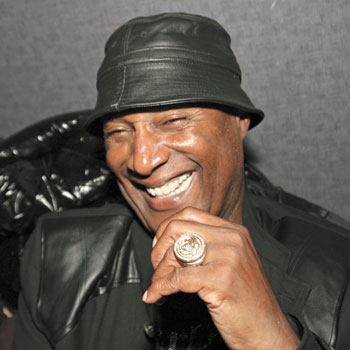

At a friend’s cottage last summer, my buddy left behind a book that I scooped up, intending to return it. I never got around to it. And I’m so glad because otherwise I never would have read Paul Mooney’s wonderful autobiography Black Is the New White.
Who is Paul Mooney? You may know him if you’re a fan of Richard Pryor. He’d be on your list of comedic heroes, as the writer of much of the late comic’s celebrated stand-up, not to mention his own brilliant solo work and involvement in Dave Chapelle’s TV series.
The book is a gem, covering his early childhood in Louisiana, his teenage years in Oakland and his tentative decision to hit the public stage as an actor and comedian in the late ’60s. He was part of Jane Fonda’s anti-war troupe that played outside of military bases in the Vietnam era, the beginnings of a life of controversy and significance.
Then Mooney met the man who changed his life, Richard Pryor. The connection was immediate; the interplay between them electric. The major difference between them? Mooney doesn’t do drugs. He’s candid about his best friend in the book, admitting that “Richard was an addict first, and everything else after that.” But you can feel the love he has for Pryor.
I brought Mooney to town in the early ’90s as part of the now defunct People’s Comedy Festival. He was suspicious of this white boy until I audaciously told him I thought he was holding back in his act. The next set he let out all the stops, using the “N” word about a thousand times. “That’s the fearless genius I hired,” I crowed to him afterwards.
Lately he’s been the midnight fixture at Caroline’s in New York. Sitting on a stool in a beautifully cut blazer, swilling a brandy he barely touched, Mooney has lost none of his charismatic impact.
One of my great regrets in life is that I never saw Pryor live in concert. But there were other key African-American comics who spoke similarly about race from that era that I loved as well: Godfrey Cambridge, a kind of black Woody Allen with great one-liners who died much too young. Cosby was the comic we would all listen to on records played in our parents’ rec rooms. And then there’s the great Dick Gregory. I once saw him do a four-hour concert in 1972 at a club on Hazelton Avenue in Yorkville. With topics ranging from racism to nutrition to meditation, that concert by Gregory was one of the comedy highlights of my life.
Today, it’s Chris Rock who leads the pack — but perhaps only because Dave Chapelle is missing in action. But where are the new voices of African-American stand-up?
I asked Kenny Robinson his thoughts on the matter. Robinson is the premier black comic in this country, creator of the famed Nubian Disciples of Pryor show. He brought up some good names.
D. L. Hughley, for one: I forgot about Hughley’s CNN show that showed him to be a contender for the Jon Stewart mantle. Robinson also recommended Kevin Hart. Hart’s concert film Bring the Pain cracked the top 10 movie charts for a few weeks this year.
I would add Hannibal Buress. He approaches comedy from a surreal point of view, an African-American Steven Wright. But his offbeat musings could be of any and all colours. Maybe that’s the way of the future.
Post City Magazines’ humour columnist, Mark Breslin, is the founder of Yuk Yuk’s comedy clubs and the author of several books, including Control Freaked.
