


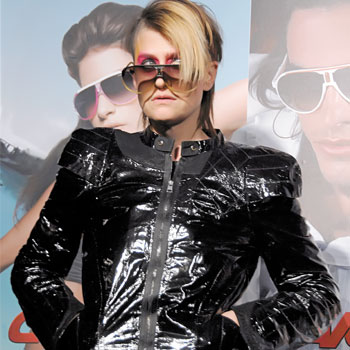

WOULD YOU BELIEVE that the underground electronic music sensation who has influenced Madonna and M.I.A.,who said no to collaborating with Britney Spears and yes to filming and starring in her own Super 8 biker adult film was once an independent drama and music instructor at the YMCA in North York?
Or would you believe that the woman known to pull off up to 15 costume changes in a single show — from a pink, skin-tight astronaut-meets-dominatrix bodysuit to a double-height black getup that looks like an armoire draped in garbage bags — was once the obnoxious kid with a cute gap tooth who played hide-and-seek at Bayview at Steeles? Peaches: international music star, former Bayview rabble-rouser.
And here’s the funniest part: for all of her wild antics — the obscene gestures, the transsexuals cavorting around on stage — when she rolls into town this winter (Dec. 21 at the Queen Elizabeth Theatre), she’ll be bringing an act that is a complete reversal of what you might expect. But more on that later.
Adolescence for Merrill Nisker, the kid who would become Peaches,was safe, suburban, sheltered. She describes her neighbourhood as “the kind of place where you couldn’t even walk to a 7- Eleven.” By necessity, she made her own fun. At age six, on a dare from the local kids near her cottage on Lake Simcoe, she snuck into a nearby cottage and stole a dish with an American dollar bill in it.
By high school, she was sneaking out of the house to go to places like the Bloor Cinema,Lee’s Palace,the Purple Institute and to hang out in empty warehouses by the railroad tracks just south of the city.
She realized early on that she loved women as much as men. Her science teacher, a woman,wore leather pants and a faux leather jacket and rode a motorcycle, and Nisker found herself smitten. An otherwise mediocre student, she ended up winning the Most Improved Science Award that year.
Diane Flacks, a local comedian who knew Nisker in her early days as a performer, remembers a funny, selfdeprecating, confident young woman with a discernable edge.
“We both grew up in suburban Jewish families, and she was pretty subversive,” says Flacks. “She was willing to make fun of things,even in school, that you wouldn’t necessarily make fun of. Whether it was the program, theatre itself, she was never going to accept it the way it seemed to be.” For school dances,Nisker’s junior high school,Zion Heights,would partner with the predominantly black school to the east, which made for an interesting collision of cultures — some 40 Jewish girls trying to keep up with dance moves that were far from kosher.
“They were awesome dancers. They knew how to do the freak, you know, the kind of dancing that is banned in some junior high schools in America now,” says Nisker.
Instead of shying away, she jumped right in. “You knew you were doing well when you were keeping up with the black kids, you know?”
After high school at A. Y. Jackson, Nisker found herself teaching drama and music to kids at the local YMCA. She didn’t play an instrument, so she taught herself guitar. “I decided I would play songs for the kids,and they would kind of move around as I told stories, and it became quite a popular thing at the schools because I could somehow wrangle the kids into learning and enjoying themselves without them going crazy and ripping each other’s hair out,” says Nisker.
At night, she played in a trio called Mermaid Café. Their music was Janis Joplin–inflected folk, heavy on the tambourine, harmonica and full of irreverent harmonies about peace, love and tragedy.“Young girls would cry when we sang this song about two gay kids in love and one gets run over by a truck,” recalls Nisker.
Mermaid Café’s success was shortlived, however, as Nisker’s bandmates in that band and successive projects soon left town, leaving her with a budding musical curiosity but no one to explore it with. Not one to let such an inconvenience stop her, she bought a keyboard and a Roland MC-505 groovebox, which allowed her to become effectively a one-woman band.
She started to experiment with new types of music, playing in a few different side projects and eventually shedding the folksy sound for something harder, rawer and more expressive of who she was. In short order, her high-energy stage antics started to attract buzz.
A friend named Leslie Feist would provide accompaniment in the form of sock puppet shows (under the name Bitch Lap Lap), and fans of Carole Pope, Mary Margaret O’Hara and Atari Teenage Boy began flocking to see the flamboyant performer who was known to do just about anything on stage.
“I wanted to show [that the technology] wasn’t rocket science, so that you could leave the machine while it was playing and jump into the crowd and come back or f**k it up or play it with your tongue or whatever,”says Nisker.
Around the same time, Nisker came across a Nina Simone song called “Four Women,” about the power of female resilience. She liked the name of the final character,Peaches,and took it as her own. “I see [Peaches] as a physical extension of myself in a format where it’s one against 500 or one against a thousand,” says Nisker. “When you talk one-on-one with somebody, you’re a certain way, but when you’re one person talking to a thousand people, you act differently.”
Around 1999, Nisker followed her craft to Berlin where, the story goes, she performed a one-off set at a small club, and a record executive who was in attendance signed her on the spot.
Her second album, The Teaches of Peaches, released in 2000, became a cult hit with fans who liked the way she embraced questions of sex and gender politics in her lyrics and onstage. The album sold 10,000 copies in its first three weeks. “A masterwork of rudimentary electronics and explicit lyrics,”wrote Spin Magazine. Her next album reached number five on the U.S. Top Electronic Albums chart,and her most recent album peaked at number five on Billboard’s Top Heatseekers chart.
This year, she was named Electronic Artist of the Year by the Independent Music Awards, a fitting reward after having sold nearly half a million records and, with song titles such as “F**k the Pain Away,” doing so almost entirely without radio support.
Nisker’s embrace of gender politics led to an inevitable backlash, with some associating her embrace of transsexuality (not to mention all other shades under the LGBT rainbow) as evidence that she was a transsexual herself, accusations not unlike those levelled more recently at Lady Gaga,an artist for whom Peaches is often mentioned as an influence. “That Lady Gaga thing, that was me five years ago,when they’re like ‘[Is she a] hermaphrodite?’ You know, that whole conversation was in the press about me, and it’s fun,”says Nisker.
Indeed,the entire Lady Gaga spectacle is very much borrowed from Peaches — from the over-the-top costumes to the sexually charged lyrics — though Peaches is more honoured than angered at the comparison.
“She obviously does specific things that I’ve done but also what other people have done — Madonna, Grace Jones — just taking [from] all the cultural icons, and I’m part of that and that’s cool,” she says. That Nisker can be so blasé about one of music’s most popular mainstream artists aping her style speaks to her success. But it might be that she has simply moved on.
To wit: today, Nisker is gearing up for her return to Toronto where she’ll unveil for a North American audience a new side of herself in the much-lauded Peaches Christ Superstar, in which she sings the entire musical Jesus Christ Superstar — every scene,every character,from Judas to Jesus.“It’s very,very goddamn exhausting, yep. It’s probably the most exhausting thing I’ve ever done,” she says. She also has a new opera in the works,Peaches Does Herself, based on her four albums and incorporating her favourite misconceptions about Peaches. But that’s not to say she is giving up on what got her where she is. In fact, after Nisker rapped with Pink on her album, Britney Spears’s management got in touch, asking about a collaboration. Nisker turned her down. The reasons why vary — some have said it’s because Spears didn’t approach her personally — but Nisker now insists she was just busy at the time and doesn’t rule out a collaboration in the future.
“Sure I’d write with her, I mean, why not? I rapped with Christina Aguilera and Pink, so I mean, it’s nothing personal,” she says. Plus, she adds, “I like her more since she shaved her head.”
