


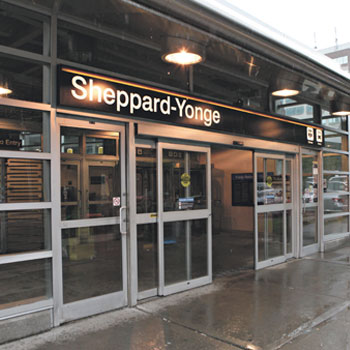

As the City of Toronto gears up for public consultations on the future of the city’s transit system, as part of its official plan review, the task of converting drivers on one of the city’s most congested roads to riders of its most under-capacity subway line continues to prove a challenge.
According to the Toronto Transit Commission (TTC), the current average daily ridership on the entire Sheppard subway line is 50,400 round trips, reaching 58 per cent of its maximum capacity during the average afternoon rush hour. Meanwhile, above ground, four Sheppard Avenue intersections are among the city’s 10 most congested traffic arteries. Not to mention, the under-capacity subway line costs taxpayers $10 million in city subsidies each year.
Franz Hartmann, president of the advocacy group TTCRiders, guessed that not enough people live in close proximity to the line to use it.
“It is really about [residential] density, and the reality is that the density that exists along Sheppard [Avenue] is not high enough to properly utilize the Sheppard [subway],” he said.
Hartmann added that providing fast transit options to the line from nearby neighbourhoods located north and south of Sheppard would encourage residents to ride the TTC.
Ward 16 councillor and TTC chair Karen Stintz said a light rail transit (LRT) system would see a boost in ridership.
“I believe that the LRT along Sheppard will help get cars off the road and will help improve ridership on the subway because people who are now in Malvern will be able to quickly get to the Don Mills exchange and either go on the subway or go north or south,” she said.
The first round of transit talks, slated to take place before the end of the year, will present background information and establish a range of preferred transit options to study.
A second round of transit talks will select recommended transit options in early 2013.
