


Did you receive your property assessment? The Crawfords did and let me know about it. They live in mid-Toronto where they have a kid, a dog, a $170,000 family income and a Mazda SUV. Plus a $1,532,000 house.
“But we paid only $810,000 six years ago,” Joanie Crawford says, “and that was a giant stretch. We still owe more than $400,000, and now it needs a roof. Plus I’m worried sick about mortgage renewal in three years since it’s only 3.2 per cent now. One and a half million dollars? What a joke.”
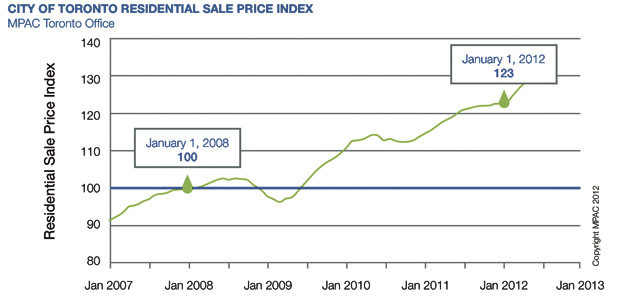
But the joke’s on them, thanks to Municipal Property Assessment Corporation (MPAC). It decides what your house is worth, then tells the government, so you can be taxed accordingly. In Ontario, residential real estate is turning into the cash cow that revenue-starved politicians are desperate to milk. So days ago MPAC told Joanie and Jason what their house is “worth,” which is $337,000 higher than four years ago, and at least half a million more than they figure they could now sell it for, in a cooling market. The increase will be phased in over four years.
“Unfair and arbitrary,” Joanie says. “We get our garbage picked up once every two weeks, pay a big extra charge for water and sewer and are screwed over by Toronto Hydro. I’ve had it.”
This is no isolated case. MPAC says the average boost in real estate assessments in Toronto is 23 per cent. Worse, the next review won’t happen until 2016, which means taxation will be based on an early 2012 market, when bidding wars were erupting everywhere and SFH prices exploding to unheard-of levels. The world’s changed. A million-dollar property selling for 125 per cent of listing price last winter is now trading for 95 per cent. That’s a $300,000 reduction in the street value of the same place, an effective 30 per cent decline in valuation, and yet taxes will be trapped at the higher assessment, even as prices dip. And correct they likely will, as the economy grinds into a low-growth phase, job creation stalls and CMHC’s decision to cease insuring million-dollar homes takes its toll in the areas where Audis migrate home at night.
Of course, higher assessments do not automatically mean higher property taxes. If a home’s assessed value increases at the same pace as all other properties in the city, then there might not be an increase, says MPAC.
In your dreams. Toronto has a structural deficit and more than $4 billion in debt. The budget chief warns of a looming crisis in 2014. Does anyone really believe a 23 per cent jump in property assessment won’t equate to a 23 per cent increase in taxes?
MPAC is the greedy and voracious agent of governments patently unable to contain their costs. Cities and provinces should be ashamed at any taxation divorced from income or the ability to pay. Worse, basing future tax on past values is deceitful.
“I feel like protesting,” Joanie says. “But we’re so busy.”
With a whimper.
Post City Magazines’ real estate columnist, Garth Turner (greaterfool.ca), is an author, investment advisor and former MP.
