

Home Blog Page 966

5 ways to jazz up your living space

0
homes pillows
homes pillows

The blahs extend to more than just your skin or your mood. They can have a full effect in the home where bright spring and summer touches just don’t feel right any more.

Here are five easy tips from some of Toronto’s top designers on how to give your home a autumnal makeover.

CHANGE YOUR ACCENT COLOUR

The Design Exchange’s president and CEO, Samantha Sannella, says this is as easy as adding pillows, candles, runners or vases in seasonal colours such as dark red or green. Nontraditional colours, like cobalt blue or light gold, make a statement and can give the impression of change without having to do too much. “Make sure your new colours don’t clash with your existing decor,” she says. “I love adding silver. It goes with everything.”

USE YOUR OUTDOOR SPACE:

Karen Kole of Cole Duron Interior Design suggests making it as festive outside as it is inside. Hang an interesting wreath on the front door or try wrapping a twig ball in twinkle lights and hanging it outside a focal window for a magical nighttime view. A fun way of keeping up with the seasons while inspiring your neighbours to do the same is in the front garden. Change your outdoor garden pots to create a festive seasonal presentation — using seasonal plantings such as pumpkins and bold coloured cabbages for the fall and twigs, branches, evergreen plants, boughs and birch logs in the wintertime.

FLOWER POWER

Flowers are an easy, fresh way to feel as though you are mixing things up. “I love a plain classic square boxwood wreath hanging from a colourful ribbon,” Sannella says. Or, use a large arrangement on the dining table, bar or kitchen island. Consider a base floral arrangement that contains holiday greens. You can change fresh flowers weekly for a colourful accent. “I always use a fresh mistletoe ball in a doorway. I tack a small nail above the door moulding and hang it from a ribbon. Fresh greens, such as pine branches, willow sticks or birch branches in pots at the front door, are great ways to welcome guests and put them in the holiday mood. Sometimes I add ornaments or grapevine balls. I have also bought twinkly lights that run on battery packs and used them in the front pots.

BRIGHT LIGHTS

Days are short as of October, so lighting is a great way to set the mood and make a difference that you will quickly feel, according to interior designer Dvira Ovadia. Make a nook where you can cuddle up and read next to some soft, romantic lighting. Ovadia recommends looking for light fixtures that are energy efficient and introduce dimmers to save energy on some of your existing heavy-duty light sources. For subtle alternatives that will keep your home feeling cozy and romantic, light up your fireplace and use candles in areas like the living room and bedroom.

FINAL TOUCHES

The little things can sometimes make the biggest difference, especially when it comes to making you feel at home in your own home. Kole recommends you invest in some interesting coffeetable books and use them as accessories stacked one on top of another — either on or under a coffee table. A colourful mohair or cashmere blanket offers functional design, but you can also layer a beautiful needlework throw, kilim rug or suzani over the back of a sofa for added interest, warmth and colour.

What to make for 1,000 hungry guests

0
susur kitchen 1
susur kitchen 1

I should be packing to leave for Los Angeles, but instead I’m running around making hors d’oeuvres for one thousand people for the New York Magazine’s 11th annual “NY Taste” in Tribeca. Do you want to know what I’m preparing for a thousand hungry guests?

Peking onion pancake with hot smoked salmon, topped with a crème fraiche of lemon, horseradish, chive and salmon caviar. It’s a dish I made for the Susur Lee-Daniel Nestor fundraising event in Toronto in September, and it got a great reception.

On Nov. 19, to celebrate Shang’s one-year anniversary, I’ll be hosting a pre-holiday press dinner for food critics in New York.

I’m putting together some elaborate dishes in Chinese banquet style that will knock them out of their booths! Ruth Reichl, who used to edit Gourmet magazine and now hosts her own television show, will be there and I always look forward to seeing her. I also want to introduce the media to the new Asian cuisine that we’re serving at Shang, and remind New Yorkers that they haven’t tasted everything.

Chef Susur Lee maintains two successful restaurants in downtown Toronto – LEE and MADELINE’S — and now has restaurants in New York (Shang) and Washington (Zentan).

Six ways to warm up your wardrobe for fall

0
franco model
franco model

I really love the fall season, watching as women slowly come out of their summer clothes and start to pile on the layers. From my perspective as a designer, here’s a list of six things to be on the lookout for while shopping to update your wardrobes this season:

1) Colour/Fabrics

I love the play of colour for fall. Black, charcoal, chocolate and navy are always great bases for playing off against shots of red, mauve and even yellow. Look for wonderful fabrics that feel good against your skin. If you can afford them, look to cashmere, wool and trans-seasonal viscose blends. Try to find garments that have lycra or spandex for that added comfort. Makes them great for work or travel.

2) Jackets

Look for garments that have a soft texture, interesting tweeds/boucles, colourful plaids, over-sized checks or even stripes. Look to jackets that have a slight 80’s retro feel and come with zipper details or gathered puffy sleeves. Some jackets use over-sized buttons and even come belted. Try to include what I call the non-jacket: rich knit fabrics cut into jackets that even double up as outerwear and can be worn with jeans.

3) Pants

Should be on the skinny side. I love the new black double knit pencil pant with zipper details on the back of the leg or at the bottom of the side seam. The bottom should be no more than 12” (30cm). If you are buying a tailored pant, I like those worsted wool/lycra men’s wear fabrics and details like 1/4 top pockets and side seam tabs. Some pants come with soft pleating at the waistband.

4) Skirts

My favorite this season comes in a skinny pencil silhouette, maybe a higher, fuller waist and then tapered at the bottom — hovering just above the knee.

5) Shirts

Smooth cotton sateen combined with lycra in solids and men’s wear stripes are my favourite. Novelty jacquards all cut into skinny boy’s inspired shirts, shirts with zipper closures, 1/4 sleeves and sexy ruffles are a great way to soften things up a little.

6) Dresses

I love tailored dresses that can take you from the office to cocktails after work, dresses that make you look slender and sleek, and those with retro collars and structured seam details. The dress can be layered over a shirt and used as a jumper. Just make sure it doesn’t go past your knees in length.

Remember, no matter what, don’t buy it because it’s trendy. Buy it because you love it and it’s made of great quality. And if you really want to make this Toronto fashion designer happy… BUY CANADIAN!!

Ciao for now.

Franco

With three corporate stores in Toronto, Franco Mirabelli continues to distinguish himself as one of Canada’s strongest fashion talents. Keep up with him by following his weekly blog at PostCity.com or by visiting mirabelli.com.

Best brunch: Perfectly poached eggs on College

0
poached egg
poached egg

You won’t get scrambled over the $13 eggs. They’re that good.

Mitzi’s on College serves up weekend brunches yummy enough to keep hungry hipsters waiting 30 minutes for a table.

Its comfy living room appeal is the perfect complement to delectably firm poached eggs with a drizzly centre, bathed in a cheesy sauce and paired with fresh multigrain toast, fruit and fried potatoes.

Even though it’s only steps away from dripping-in-cool Ossington Avenue, Mitzi’s on College caters to families and coffee-sipping, newspaper toters alike — all who come in peckish and leave in a hazy food coma.

The original Mitzi’s (100 Sorauren Ave.) opened 13 years ago. Nestled on a residential corner in Parkdale, locals snuggle inside like sardines to chit-chat with neighbours and eat homemade muffins and eggs.

Its popularity gave rise to Mitzi’s Sister (1554 Queen St. W.), the bigger and wilder sibling, which opened six years ago around the corner. The menu boasts hearty selections, like hamburgers, sweet potato fries and locally brewed beer. The second of the three Mitzi’s is known for its late night live music.

Mitzi’s founder Leslie Gaynor’s third venue on College isn’t any less tasty. Make sure to sample one of the chain’s signature favourites, oatmeal buttermilk pancakes, with a different topping every week.

890 College St. W., 416-533-7400

Fall in love at magical boutique on Queen

0
love queen
love queen

Love of Mine is a magical new boutique on Queen Street West with really interesting accessories and a few unique clothing pieces. My eyes begin to sparkle as soon as I walk into this boutique and notice the décor: butterflies fly across one wall, a neon pink painted antique chair with pink and beige chintz sits beside the display cases, and a lovely chandelier hangs above.

Most of my favourite accessories are encased in a glass wall with sliding doors so you can easily view their individuality. The pieces that stood out to me most are made by the sisters at Green Beads and look like jeweled collars. They are chunky pieces that would change any plain clothing pieces into a put-together outfit.

I’m also really impressed by Eliza Kozurno’s work. Eliza is a Toronto designer who uses her background in fine art to create artistic pieces that make a statement. If you appreciate intricate designs with many details, you too will love Eliza’s pieces.

The Yarnz NY scarves in the back of the store also catch my eye, specifically a gorgeous light blue scarf with a big bright red floral print.

Love of Mine is ideal for women who are looking for unique pieces to add a little sparkle to their personal style.

Love of Mine is located at 781 Queen Street West, Toronto – 416.368.4999.

Always on the lookout for Toronto’s best boutiques!

Wendy

As a personal style coach with THE REFINERY, Wendy Woods translates the world of fashion into a personal style that makes her clients shine, while introducing them to Toronto’s unique boutiques.

H1N1: Keeping your kids healthy, despite the odds

0
sneeze
sneeze

Though thus far the spread of H1N1 hasn’t proved terrifying, we continue to make the assumption that it is going to rise to pandemic levels this season. We have been wrong before. However, waiting to see if it will be as bad as predicted is not an option. We must all assume the worst and be prepared.

H1N1 is a real nasty little “bugger.” Any decent virus would at least take a break in the summertime, but H1N1 persisted throughout the warm months. With school back in session and children mingling more than in the summer months, the risk is higher. The virus loves to reside where people assemble.

The only possible way we might have stopped H1N1 would have been to not open any schools until at least two weeks after all attending children were vaccinated with the H1N1 vaccine and had shown documentation to confirm this. That is what was attempted in Kuwait. However, many factors made such a plan practically impossible in Canada.

What do you need to know to keep your kids healthy? First, it is known that the incubation stage for H1N1 is approximately four days. The total illness from start to finish may be up to two weeks. During both the incubation phase and the acute illness phase the virus may be spread by droplets (from sneezing, coughing or even tears).

The virus can also live on surfaces for several hours or days.

Will wearing masks help prevent the spread of H1N1? The answer is yes, but only if one wears a personally fitted N95 mask and wears it properly. So ultimately, the answer is no. Wearing any other type of mask will likely give a false sense of security, causing people to be more casual about their behaviour and the potential spread of the virus.

The only positive effect of wearing a mask is that it will help decrease the amount of touching of the nose and mouth by the hand and thus lessen the spread of the virus on surfaces or directly by touch. Face masks in general are very uncomfortable to wear — and all too often will be removed — to be of any real help.

When we send our kids off to school, are we throwing them into a cesspool of disease? The answer is absolutely not. Schools around the world are doing their best to prevent the spread of the virus. Hand-sanitizing stations are in place. Common surfaces are washed more often. Tissues are in abundance. Children are being taught to “sneeze into their sleeve.” More wastepaper containers have been made available. The schools are doing their part.

Schools are also reviewing, on a regular basis, their methods of prevention of virus spread. Teachers are on high alert to watch for any child with symptoms of an upper respiratory tract infection and have been tasked with taking the appropriate measures to get any ill children home safely.

What can parents and caregivers do at home? Previously, you may have sent a child to school with a mild upper respiratory tract infection, particularly if the child was not feeling ill. These days, that would be a mistake. The seemingly mild, initial symptoms of a respiratory tract infection are the initial symptoms of H1N1 and will last for two to three days before the more serious symptoms become apparent. During these first days of mild illness, the child is extremely contagious, spreading high volumes of the virus.

It is therefore extremely important to keep such children home from school. Although this may be difficult for many families to manage, it is essential. Everyone must realize how serious this disease can be and take the appropriate measures to prevent its spread.

The bottom line is that it is virtually impossible to prevent the spread of H1N1. Children are still children. Their hands are constantly touching their faces, and their games (playing catch or ball for example) spread germs. That said, there is a lot we can do. The most important thing is education.

Teach your children how to prevent the spread of droplets and how to properly use hand sanitizer. Your job is to keep a constant vigil for the beginning of any viral illness. I highly recommend vaccinating all children over six months of age. My grandchildren will certainly be vaccinated.

The ostrich approach: why just saying no doesn’t work

0
parent parent
parent parent

Now that my kids are on the safe side of 20, it’s clear who they are. I sigh with relief and jump for joy that we raised two resourceful, kind, hard-working young adults who make good choices and have plenty of drive to do both good and well in the world.

But ’twas not always thus.

There was a time, when my son (a.k.a. Party Boy) was 14, and I made phone calls to four or five moms in the neighbourhood to talk about drugs. I said to them that I thought the boys were smoking a lot of dope, including probably on school nights, and I proposed that we parents meet to problem solve.

As individuals we were powerless against the lying, cheating teen juggernaut. Short of putting kids on house arrest, there was no way to stop them using any available “empty” (parent-free house) to smoke up.

I had been telling my kids for years to say no to drugs. This (the “ostrich” approach) worked great for my peace of mind — until I found out that my telling them not to do it was about as effective as telling my dog not to run away in the park. As parents it is so hard for us to accept that our teens disobey our directives routinely — almost for fun.

And once I accepted that, my parenting strategies became more realistic.

Hence my shock at the other moms’ reactions. They all said pretty much the same thing: “Oh, my son would never do that.” At which point I knew two things: 1) What my son would be doing at their houses and 2) I was on my own.

Those two realizations led to two choices: 1) Let it go or 2) Beard the lion in his den. The first alternative neither meshed with my parenting style nor offered peace of mind. I was terrified that my child was in danger of going down a bad path; it was clear that my admonitions about drugs being not good for him weren’t exactly achieving success.

I recalled my definition of “stupid” (the person who does the same thing over and over again even though it doesn’t work) and girded my loins for a new tack.

The only approach I could figure out was to start an honest conversation, in hope that if we could open those blocked lines of communication. I had a shot at gaining influence. Which began with the unimaginable (to many parents) admission that I knew what he was doing drug-wise and was not going to freak out about it. That surprised him, and suddenly we were in the room together.

The next step, which unfolded over several years, involved me sitting on my hands (oftentimes literally, as a memory aid) and listening non-judgmentally. This of course is that hardest thing for us to do as parents of teens because we persist in the pathetic illusion that if we talk enough we can change their behaviour.

Truth: We can only make them lie more — which is the opposite of communication.

So I listened … and listened. To stories of partying, drugs and alcohol. Pretty soon after I started listening, the miracle occurred: I could see his face change when we talked.

I could see his ears open occasionally to me. If we stay quiet enough, when teens talk, we catch those rare moments.

I thought out in advance what was really important to say to him and used those moments to deliver my key messages: 1) If you smoke dope on a school night I’ll kill you (just kidding, but it was important). 2) Never never never any other drugs. 3) Practice moderation. I think he preferred not lying to me, and I know that he was pretty good about the three big points — because I paid close attention.

Part of this strategy involved not being out of the house very often after 10 p.m. on weekends and smelling his breath (for smoke and mints) when he came home on weeknights. When teens hung around my house, I made a round every half hour to make sure everyone was safe.

The strategy made this phase of parenting as onerous as parenting a toddler — just a different kind of supervision. It was like teaching your little one to cross the street — far too important and risky to abdicate parental responsibility by looking the other way.

Fame and family

0
yummy nov
yummy nov

When my kids were preschoolers and I was exhausted, many mornings were spent watching TV. That’s when I first saw Patty Sullivan, the pixieish host of the preschool-targeted, commercialfree Kids’ CBC.

Her character, Patty Talkalotagustachuck was our family favourite. She has a daughter, Veronica, who is almost three now, and Sullivan has been back at work for two and a half years as a producer, writer and host.

Part of her success as a performer is her ability to focus on the preparation.

She laughs about how that skill served her well as a new mom, too.

“I was stressed out about everything ‘baby,’” she says, “so I researched everything online, signing up for every website newsletter, joining every mommy group.

I was overprepared. But I’m still a crazy worrywart, which I never was before kids.”

She devoured baby books like How to Have a Baby and Still Live in the Real World: A Totally Candid Guide to the Whole Deal, by Jane Symons and Gila Leiter.

“I laughed at all their jokes while it still hit on all the important parts of pregnancy and beyond,” she says.

I speculated that being a part of the Kids’ CBC TV show for years must have made the transition to motherhood a little easier for her. “Wrong!” she almost shouts.

“Just because I’m the host of a children’s show, doesn’t mean I have any better idea of what to do with parenting kids. I’m also at a loss and just as scared.”

Besides that, the fame thing doesn’t really play at home. I ask Sullivan if she’s ever scored extra points with her daughter by being a preschool celebrity.

“My daughter has no idea I’m famous even though she watches me on television,” she says. “One day, when she’s older, she’s going to realize that not everyone’s parents have their own show.”

Occasionally Veronica will get a first-hand glimpse of Mom as a performer, often at dinnertime. In order to persuade her little picky eater to partake of various dinner offerings, Sullivan will take advantage of her range of cartoon voices. “Yesterday I got Veronica to eat her carrots using a silly voice and pretending the carrots were asking her to put them into her tummy. It worked! But usually I’m all business with her.”

As much as Sullivan adores creating and hosting TV segments, she focuses a lot less on her career these days and more on her daughter.

At the same time, when she wants a job, she still goes out and gets it.

Just last December she sparkled on stage playing the godmother in Ross Petty’s hilarious production of Cinderella.

My kids were transfixed each time she came onstage. Despite her fame, she wasn’t just offered the role. She was a huge fan of Petty’s plays and started an e-mail campaign to get his attention, land an audition and win the role.

As much as her daughter loved the performance, she wasn’t thrilled her mom was rehearsing long hours and virtually disappearing during the show’s run. To deal with her bouts of guilt, Sullivan talks about it with her husband, Mike Kinney, who is also a performer and producer.

“I even have guilt when I go out with my friends for the night, but I do it because I know I have to do it for me. Things are never going to be the way you want them to be.

“So you might as well laugh.”

Post City Magazines’ parenting columnist, Erica Ehm is the voice of yummy mummies with her playful website yummymummyclub.ca. After all, mommies need to play, too.
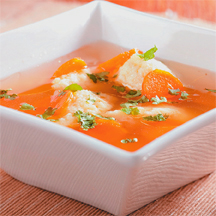
Three chicken soups for the soul

0
chicken soup
chicken soup

Chicken soup is a classic staple during cold and flu season. Most cultures have their own form of it, and it is seen as a sickness remedy all over the world. (It’s even known as “Jewish penicillin” in some circles.)

Chicken soup does seem to relieve symptoms like a stuffy nose and is the perfect food when you have no appetite. Canadians love their soup with vegetables and soft noodles while the French serve it with garlic and fresh herbs. In Germany, chicken soup is served with dumplings or spätzle, and Chinese varieties are served with ginger and scallions.

Producing your own stock is always best, but if you haven’t the time, look for an organic chicken stock that’s lower in sodium and contains no MSG. Here are three very different chicken soups from Asian, Italian and eastern European cultures for you to enjoy.

Italian chicken and meatball soup

Mini matzo ball soup

Sesame udon noodle soup

Rose’s Tip:

Here’s a fail-safe way to make your own chicken broth: For 10 servings cut a 4 lb chicken into 8 pieces. Place in large pot covered with cold water. Bring to a boil and skim off layer that comes to the surface. Add 2 onions quartered, 2 stalks of celery sliced, 2 medium carrots sliced, a bunch of fresh parsley and salt and pepper. Bring to a boil again, reduce the heat to a simmer and cook for 90 minutes. Strain and serve.

Post City Magazines’ culinary columnist, Rose Reisman, is author of 17 cookbooks, a TV and radio personality and a health and wellness expert. Visit Rose at www.rosereisman.com.

For $5 more, a new world of wine

0
aspler
aspler

THERE ARE 2.7 BILLION cases of wine produced every year around the world. What is more significant is that 70 per cent of these wines are sold at less than $10.

If you raise your sights from Fuzion and its ilk (the Argentinian blends at less than $8 flooding the stores) and you are willing to spend more on wine, you will find that there is a great leap forward in quality as you enter the $14 to $20 bracket. With this in mind, I offer you five wines new to our market that will repay in pleasure the extra dollars you’re spending.

Sabor Real Vinas Centenarias Tempranillo 2005 (Toro, Spain, $19.95): The vines from which the grapes were harvested for this wine are more than 100 years old. Toro is a warm growing region, which means high sugar reading that ferments to alcohol.

This wine is 15 per cent. Dense purple in colour, it has a nose of spicy chocolate and blackberries and black cherries. Try it with venison or rich stews.

Waimea Sauvignon Blanc 2008 (Nelson, New Zealand, $17.95): The Nelson region is located in the very north of the South Island.

The weather here is cooler than Marlborough, the spiritual home of Sauvignon Blanc in New Zealand. Light straw in colour, the wine has a bouquet of green plums and nettles. It’s crisply dry with a tart gooseberry flavour and lively acidity, which gives the flavour great length. Match it with goat cheese or seafood salad.

Ringbolt Cabernet Sauvignon 2007 (Western Australia, $19.95): Margaret River is one of my favourite regions in Australia, making elegant, more restrained wines. A beautiful balance of cassis and cedary oak with a core of sweet fruit. What gives this wine distinction is the floral note on the nose and palate. A wine for red meat dishes, simply prepared.

Pala Crabilis Vermentino 2008 (Sardinia, $13.95). If you’ve never tasted a white from the island of Sardinia this bargain wine is a great place to start. The Vermentino grape is a late-ripening grape related to Malvasia. Bright yellow straw in colour, the nose and palate are complex and full on the palate with flavours of lemon oil and peach. The wine has enough concentration to match with lobster or with pork dishes.

Mission Hill Reserve Pinot Gris 2007 (Okanagan Valley, $19.95). We don’t see many B.C. wines in our market. This one is deeply coloured with a peach and vanilla oak nose; it’s full-bodied with a sweet peachy fruit balanced by citrus acidity. Try it with roast chicken.

Acts of God, or do humans have something to do with it?

0
suzuki
suzuki

INSURANCE COMPANIES, politicians, and business people often use the expressions “natural disaster” or “act of God” to deflect responsibility for events beyond our control. Now, human activity and technology have become so powerful that we’re contributing to what were once natural disasters.

Tornadoes, storms, hurricanes, floods, pest outbreaks, heat waves, and even earthquakes are occurring with greater frequency and intensity than ever.

Some of this can be traced to human activity.

Greenhouse gases, large dams, and deep oil and water wells can all affect Humans appeared during the last period of evolutionary time, perhaps 150,000 years ago.

For most of our existence, we didn’t even know whether other humans lived on the other side of an ocean, desert, or mountain. We only had to worry about our own tribe.

Suddenly, we have become a geological force, the most prolific mammal on the planet, endowed with powerful technologies, impelled by an insatiable appetite, and supplied by a global economy.

Our numbers, technology, and global economy have made us a new kind of force on the planet. For the first time, we must ask, “What is the collective impact of 6.8 billion human beings?” As we answer that question, we’re left with the problem of responding to global threats that we’ve caused.

Many people harbour an understandable tendency to deny the reality of the crisis in the biosphere. After all, how can puny humans have such a massive impact on this large planet? Some also maintain a conceit that we can manage it with heroic interventions of technology.

But we’ve learned from past technologies — nuclear power, DDT, CFCs — that we don’t know enough about how the world works to minimize unexpected consequences.

The truth is that the only factor or species we can manage on Earth is us. We have no choice but to address the challenge of bringing our cities, energy needs, agriculture, fishing fleets, mines, and so on into balance with the factors that support all life. This crisis can become an opportunity if we seize it and get on with finding solutions.

Preparing to be Jie-afied

0
jie cut
jie cut

UPON MEETING THE AREA’S most expensive hairstylist, one learns immediately there’s lingo to be learned. Jie Matar, who charges $400 for an initial cut, is not going to simply cut and style my hair. He’s going to “Jie me.” When he’s done, I’ll not only have a new look, but I’ll be “Jie-afied.”

To be brutally honest, I wasn’t looking forward to meeting Jie. When I found him, working out of a discreet hair salon called 186 Davenport, and called to ask how much a haircut with Jie is, I was told by someone, somewhat shadily, “We don’t give that information out.

You have to come in a see Jie first.” When I first speak to Jie and mention photos, he wants to know who the photographer is, how it would be “styled” and, I think, he mentioned his “agent.” The whole $400-for-a-haircut thing, coupled with a paranoid and egotistical hairdresser with an agent? Too much for me.

Surprisingly, I end up adoring him. Jie, who is half-Lebanese and half-French, went to boarding schools in Turkey, France, and Egypt, which his family fled from in 1977, following a civil war. He ended up studying at a Paris hairdressing school in 1985, before moving to Toronto.

What happened after he moved here could easily be turned into a movie of the week.

In 2002, with a client base of 10,000 names, he opened Salon Jie, on Avenue Road, with a splash. Forty hairdressers worked at his salon, and there was easily a threeweek waiting list for a consultation with Jie in his “private cutting theatre.”

At Salon Jie, he kept his scissors in a $12,000 Louis Vuitton case, had celebrity clientele and also made many enemies. In the world of hairdressers, excuse the pun, it’s cutthroat.

“The difference between me and Jie is that my clients are more famous than me. Jie is more famous than his clients,” Robert Gage, another famous Toronto hairdresser, once said in an interview. (For the record, when I call to ask about Gage’s prices these days, they were a bargain at $130.)

Then financial troubles hit Jie. Owing hundreds of thousands of dollars — to contractors and the taxman — he was forced to close Salon Jie.

“It’s hard to be the best,” he sighs.

Though he lives in Yorkville, two blocks away from where he works, he never walks to and from. “I can’t walk because too many people will stop me to talk,” he says.

This is the same reason he hasn’t shopped in Whole Foods for two years.

“I still wish people would leave me alone, asking about it,” he says. He realized who his true friends were though. Most, surprisingly, were his clients.

Under all the bravado — which grows on you, seriously, it makes me crack up — he has a heart of gold. One of his clients tells me that her sick mother can’t leave her apartment and that Jie goes to see her. “And he makes her laugh,” she says.

He makes me laugh, too. “Of course you must love your hairdresser! It’s like your second husband,” he exclaims. Or, “You can’t come in here depressed. You have to be happy. I don’t have time for angry hair.”

When he looks at my hair he announces he’s going to make me look less Greek (I’m not Greek at all, and I like the Greek look!) and less “Alanis Morrisette circa 1990.” (Which I understand.)

I’ve grown my hair for almost a decade, and I moan I’m not ready. Basically, Jie doesn’t listen, which worries me but also, weirdly, reassures me. (You want your doctor to be certain, and I want my hairdresser to be certain.) He also tells me he’s going to lighten my hair to make me look more “Sarah Jessica Parker.”

I sit in the seat that was previously occupied by such celebs as Paris Hilton, Tori Spelling, Kim Catrall and Nelly Furtado. (Jie’s the one responsible for Furtado’s heavy bangs a few seasons ago.)

Jie tells me to lean forward, grabs my hair in a ponytail and snips it off as I feel my heart sink.

“Don’t worry,” he’s the best, a statuesque young woman says to me, after listening in on my worries.

(Every time Jie says he’s the best, a client also seems to say it.) Jie, too, works fast. For me, getting a haircut is somewhat of a chore, and Jie’s clientele are busy.

“I can get you in and out of here under an hour,” he says.

Twenty minutes later, I see what he’s done with my hair. I’m Jieafied! And loving it.

Though the salon is far from bustling, Jie still sees 15 to 22 clients a day. The salon is definitely private and quaint.

Does Jie worry that charging $400 a cut in these economic times is too much?

“No, during a recession, women are more concerned about how they look because their husbands are spending more time at the office, so they want to look good for them.” The storm has clearly passed — maybe there should be a second movie of the week called How Jie Got His Groove Back.

And, just for the record, Jie wants people to know, “I never said I was the god of hair. Someone wrote that in a headline, and that’s what people think I said.” It’s OK, Jie. I’ll say you are.