
Home Blog Page 950

Stacey Farber

0

FOR ALL HER years in the spotlight as a teen, North York’s Stacey Farber was still startled at seeing her own face staring back at her at the Yonge and Bloor subway station recently.

For about a week last month, posters for Farber’s new CBC show, 18 to Life, in which she stars as an 18- year-old who marries the boy next door, were plastered just about everywhere she looked.

Or stepped, for that matter.

“I got in the back of a cab, and they were lining the floor of the taxi with our ad,” recalls Farber in between sips of Perrier at a midtown café.

“So I got in and put my muddy boots on my face. It was so surreal.”

But probably less so than if you or I were to experience the same thing.

The 22-year-old Farber has been getting used to public prominence, after all, ever since she signed on as Eleanor “Ellie” Nash on Degrassi: The Next Generation upon finishing junior high at Claude Watson School for the Arts.

The show proved to be fertile ground — while living up to its name — for producing the next generation of stars.

First it was Shenae Grimes (who played “Darcy Edwards”) off to Hollywood and a starring role on the remake of 90210; then came Aubrey Graham (“Jimmy Brooks”), who refashioned himself “Drake” and took hip hop by storm; next was Nina Dobrev (“Mia Jones”), the latest young beauty to be out for blood, on the hit series The Vampire Diaries.

And now, with the success of 18 to Life, it’s Farber’s turn in the spotlight.

In January, the show premiered to none-too-shabby numbers, beating out CBC mainstay Little Mosque on the Prairie and increasing its ratings with its next broadcast.

But tell Farber she’s “made it” at your own peril. For someone who’s got two successful TV series under her belt at the tender age of 22, she’s viciously humble.

“I don’t think I’ve made it,” she says, bristling. What she will admit is typically understated: “It’s been a good year professionally,” she says.

Why, exactly? Reluctantly, she lists the items she has checked off her to-do list of late: “be nominated for a Gemini; work on something other than Degrassi; and be on a billboard,” she says, turning slightly pink.

In 18 to Life, Farber stars opposite Gemini Award–winner Michael Seater (Life with Derek) as her young husband-to-be. Best buds since age six, the twosome strike up a budding romance that hits fast-forward when an impromptu game of Truth or Dare leads to Tom (Seater) proposing to Jessie (Farber), who accepts.

Peter Keleghan plays Tom’s conservative neat-freak dad (he Dustbusts the lawn) to perfection, alongside Ellen David as Tom’s overbearing mom, while over the fence and across the overgrown yard are Jessie’s free-love civil unioners, played with hippie aplomb by Alain Goulem and Angela Asher.

Despite parental interference from the diametrically opposed parents, the marriage happens anyway. And with that, the series unfolds, following the two youngsters as they navigate the dangerous waters of early onset adulthood and the concomitant complexities of love, sex, commitment and money.

Farber pulls off the role of a young newlywed convincingly, and not just because her diminutive frame makes her seem hardly older than the 18- year-old she portrays. In person, Farber evinces the same innocent charm and genuineness as her onscreen character, Jessie.

But as good as Farber is as a young newlywed, she’s not the type to launch into something so serious as marriage at first impulse.

“I’d probably have commitment issues,” she says without hesitation. “I’d have a hard time imagining that I could spend the rest of my life with someone starting at the age of 18. That’s a little extreme.”

Chalk it up to the capriciousness of youth but also to the fact that Farber’s got too much on her plate these days to even think of settling down.

Before filming began on 18 to Life, Farber was deep in studies at the New School, a progressive liberal arts school in Manhattan where she majored in fiction and minored in journalism. Along the way, she interned at Teen Vogue, Nylon and Allure magazines and has plans to write a complete screenplay within the year. “Just to say I’ve done it, she says.

Today, diploma in hand and back in her hometown, she’s busy with promos for the show and has rented a North York apartment that’s a couple of stops away from her childhood home at York Mills and Bayview.

Farber’s memories of Rollerblading, building snow forts and walking her dog paint her upbringing as safely suburban, but it’s her “favourite” memory that makes it seem downright idyllic:

“I remember going to Bella Carmela [at York Mills and Leslie] one day when the power went out. They were giving away free ice cream because everything was melting. I remember that,” she says with a smile.

In middle school, Farber mixed with a crop of talented young performers at the artsy enclave of Claude Watson. One of those kids was Jake Epstein, a future Degrassi star and the current lead in the hit musical Spring Awakening. Before long, Farber had hired an agent of her own and signed on, along with Epstein, to Degrassi, which meant she spent a large part of her time away from school. But there was no avoiding the classroom. During breaks on Degrassi, she, Epstein, Graham and the other castmates kept up with their studies with the help of a tutor.

“We were all in one room, not really getting any schoolwork done. We’d help each other with different subjects,” she says. These days, with their rising careers, the group of them are more likely to see each other on TV than in person, for the time being, at least. Still, the connection remains strong.

“We went through something that it’s hard to talk to other people about. We grew up on TV together. Looking back, we have fond memories,” she says.

But working on 18 to Life has meant a slew of new experiences for Farber, chief among them getting to know her on-set hubby off the set. Recently, after Seater won a Gemini for Best Performance in a Youth Series (edging out Farber for her work in the Degrassi movie), Farber, Seater and friends took to the town to celebrate.

“Michael had his Gemini and everyone wanted to touch it,” says Farber.They all ended up at a drag bar in the Church-Wellesley district, where they were pulled up onstage to play “Are You Smarter Than a Drag Queen?” — which Seater apparently was, making him 2 and 0 on the night.

Friends off-screen and newlyweds on, the twosome share a chemistry that has so far made 18 to Life a relative success. But in typical fashion, Farber deflects the credit in the direction of her co-star.

“He knows way more than I do about how everything works in television. I trusted him and felt safe having him guiding us through the whole thing.”

If Farber stays on her current trajectory, she may soon decide she has in fact “made it.” But that may depend on where we — or rather she — will see her face next.


 

Chris Rudge

0

BY NOW, WE’VE heard all about Canada’s ambitious Own the Podium Olympic project, but Chris Rudge, CEO of the Canadian Olympic Committee (COC), one-time Thornhiller and chair of the Own the Podium Committee, has been hearing about it for the past half decade.

As the Vancouver 2010 Games kick off,he’s as anxious as anyone to find out whether five years of an Olympic-sized effort to support Canadian athletes will pay off.

February will tell the tale of exactly how much our nation’s Olympians will benefit from the Own the Podium program, an initiative designed to develop athletic talent in order to increase Canada’s Olympic medal count. The program was funded in part by the COC, the organization Rudge helms as chief executive officer and secretary general.

Launched in 2005, the program invested $110 million in science, technology, medicine, travel and competition development for Canadian athletes leading up to the Games.

It’s arguably a much-needed investment. In the two Olympics Canada has hosted (Calgary in 1988 and Montreal in 1976), no Canadian has ever won the gold on home soil, something Own the Podium is out to change.

“A number of leaders in the sports community recognized that we had not been successful at hosting the Games in the past,”Rudge says.“Our teams didn’t do as well as one might have hoped. Recognizing this,we felt that we had to do something to improve the chances of the team to perform well in 2010, and in order to do that,we had to perform a pretty thorough analysis of where we were with our sports programs and decide what needed to be done. That was really the genesis of what went into the thinking of the program.”

It’s a labour of love for Rudge. He’s an avid sportsman and prolific volunteer who coached the Canadian National Field Lacrosse Team in 1976, played for the National Lacrosse League’s Syracuse Stingers and taught phys. ed. in GTA high schools during the 1970s. Later, he held senior positions at Quebecor World Inc. (one of the world’s largest commercial printers), Maclean Hunter Printing, QueNet Media and the Financial Post.

The experience in both the corporate and teaching worlds gave him the combination of business acumen, mentoring and communication skills the COC needed. But for his part, joining the committee was more about following the wife’s orders ( Janet Nutter, a diver at the 1980 Olympics and 1978 Commonwealth Games medalist) than anything else.

“Well,I’ve done a lot with my life,”he says. “And after I retired in 2003, I had been working out pretty heavily at the Thornhill Extreme Fitness at Yonge and Highway 7 for about a year. My wife said to me, ‘You’re driving me crazy. Get off your butt and find something to do.’ So I ended up joining the Olympic committee.”

As a former long-time resident of Thornhill — Rudge has lived on Thorny Brae and Deanbank Drives with his family and worked as chair of the Thornhill Recreational Advisory Committee — one need look no further than local environs to see his passion for his home and for sports.

You’ll often find him practising his golf swing at the Thornhill Country Club, working up a sweat at the aforementioned gym and enjoying the peppered beef carpaccio during an evening at Tutto Bene, his favourite place in town to break bread (Not so sporty as the other two activities, but everyone has to have a little bit of fun, right?).

“The committees were very interesting politically with the to-andfroing,” Rudge says. “You had Vaughan on one side of the street and Markham on the other, and they were two very different jurisdictions. It’s like that old political saying, ‘The battles are vicious because the stakes are so small.’ But I have a deep affection for Thornhill. My wife and I were looking for a place that would suit our work and recreational needs, and Thornhill turned out to be exactly that.”

It takes that accomplished, driven person with a tremendous sense of community to put in the work necessary to make Canada a force to be reckoned with in the coming weeks. Not to say that we haven’t performed in the past given our circumstances.

Rudge would have us consider that as a young nation of less than 34 million people, we’ve done relatively well compared to the likes of perennial Olympic powerhouse countries such as the United States and Russia. And unlike other top-medal nations such as Germany, Austria or Norway, Canadians face a unique challenge in contending with the vast expanse of our territory.

“There are a lot less of us then there are in other countries,”he says.“And we in Canada have to support fully both summer and winter sports initiatives.

That really spreads the costs around.

And we have a huge geography to bridge.The Germans,for example,don’t face that. In Europe, you don’t have to travel very far to be in another country. They can be there in a few hours. Even for us to aggregate our athletes and bring them together for training can be a huge challenge. So I think our accomplishments speak well to the Canadian competitive spirit, to accomplishing our goals and objectives when we need to.”

According to athletes on the ground, it’s an objective of Olympic success much closer to being realized than in days gone by, thanks to the infusion of cash and attention paid to our competitors in the years leading up to Vancouver.

“Own the Podium is the best gift we’ve ever had as athletes,” says Olympic snowboarding hopeful Michael Lambert. “Especially at a time when the Games are in our country, we have this influx of spending. That cash allows you to do things that you otherwise couldn’t do if you didn’t have it: have extra coaching, pay to develop equipment, pay for plane tickets, alleviate your stress. If you look at the Canadian results over the last couple of years, it really shows that it’s working. On the other hand, it’s bad because I know it’s not going to be here next year, especially after seeing first-hand what it really does for us.”

So it’s not about avoiding ignominy at home (for the time being, at least!), but inspiring the nation by showing what Canadians can do when we put our minds to it, something Rudge has been looking forward to since he took the job five years ago.

“In any endeavour in life, we all benefit if we help those who have a passion to be the very best they can be,” he said.“I think in particular athletes — who have made so many sacrifices to get where they are — inspire all Canadians to do whatever they do a bit better.And I think Canadians have jumped on to support that initiative.”


Linda Frum

0

THE SENATE CHAMBER, located at the east end of the Centre Block, the main building on Parliament Hill beneath the Peace Tower, is the most imposing and magisterial room in all of Canada. It’s clothed in red, which lends it the nickname the Red Chamber, is adorned with gold leaf and polished oak. Dominating the room are two thrones, one comically smaller than the other, as though borrowed from the set of The Friendly Giant.

The upper house wears its pretensions loudly and proudly, in startling contrast to the more modest — and green-hued — House of Commons located at the opposite end of the Centre Block. It’s where the Queen addresses the country, where the Governor General delivers the throne speech and where royal assent is given to bills destined to become law.

The pomp and circumstance of the nation’s capital — not to mention the backroom machinations of federal politics — is some distance from the Bayview–York Mills area of Toronto where Linda Frum Sokolowski grew up.Yet, when she took her place as a member of the Senate last year, she found the experience strangely familiar.

“You feel like a schoolkid, like you’re back in high school and everything is foreign and strange and a little scary, and you wonder who you’re sitting beside,” she says with a shake of her head and a deep, genuine laugh.

Frum is seated in the living room of the home she shares with her husband, Argonauts co-owner and real estate developer Howard Sokolowski, and her three children. The home, like Frum herself, is bright and stylish and tastefully decked out in taupes and creams and cinnamons, with the occasional slash of grey and black.

Even her dog, a russet-coloured cavapoo named Raffy, is perfectly coordinated with his surroundings.

“I’m so sorry,” Frum says for the third or fourth time as she tries — unsuccessfully and much to my amusement — to convince Raffy that I’m not there solely to scratch him behind the ears.

It’s clear that Frum, an author, Gemini Award–winning documentary filmmaker and former columnist with the National Post and Maclean’s magazine, is less comfortable on the dangerous end of an interview. “I still haven’t gotten used to answering questions,” she says with a pained expression.

As a politician and one appointed by the prime minister, reporters suddenly have free rein to rummage through Frum’s closets looking for skeletal remains. Not that Frum’s life is an open book, just something resembling it.

Frum says she was a “nerdy bookworm” growing up who spent more time at the library than she ever did at the mall or partying with friends.

“There’s nothing my children enjoy hearing more about than what a complete loser I was,” she says. “I spent a lot of time at home and didn’t really hang out a lot. Of course, back then there weren’t many places to hang out. The Swiss Chalet, maybe, that’s about it.”

Her father, Murray Frum, was a dentist and real estate developer, while her mother, Barbara, was a highly respected broadcast journalist who hosted As It Happens on CBC Radio in the ’70s and The Journal on CBC TV in the ’80s.

“I had a pretty strong sense at the time that her work mattered and that she mattered to people,” Frum says of her mother.

Naturally, people assume that Frum was inspired to become a journalist by her mother, who died of leukemia in 1992.Frum even wrote a book, Barbara Frum: A Daughter’s Memoir, published four years later, in which she wrote in loving detail about their relationship and how she would often seek out her mother’s sage advice. But she says that it was actually her big brother, David, a journalist, pundit and political shark, who pushed her toward a career in journalism.

Frum was attending McGill University in Montreal when she despaired at the strong liberal leanings of the campus newspaper.

At her brother’s urging, she resolved to “speak out against this political stranglehold” by starting her own newspaper.

“It was a political impulse more than a journalistic impulse, a response to the singular monolithic discourse on campus. But I wouldn’t have taken a single step if it hadn’t been for David.”

When Frum speaks of her brother, it’s with equal parts affection and hero worship, and she laughs when I mention his notoriety. After all, while writing speeches for President George W. Bush, he coined the term “axis of evil.”

“I know him as someone who is wise and generous and sweet and principled and who inspires me,” she says. “And yes, he is all of the things that you’ve said, as well, infamous, notorious, but his public image is changing, too.”

When I point out that, considering his role in the Bush administration, his image could only soften, she laughs again and shakes her head.

“He’s one of those intellectuals whose opinions will never be so solid as to be impervious to new evidence. He has an extremely supple and rigorous mind. And I would say the same about the prime minister. Stephen has a tremendous intellectual capacity and strikes me as someone who’s completely obsessed with policy and what is happening in the world. He’s an egghead, and he’s a very thoughtful man.”

Just as politics drew Frum into journalism, journalism has returned her to politics. Of course, one wonders why Stephen Harper would choose Frum, a journalist (a profession considered the Enemy by many politicians) for a Senate seat.

“There’s been a very interesting evolution in the Jewish community away from the Liberal Party and toward the Conservative Party, and I’d like to think I played a small role in that process and that the prime minister is aware of that process,” says Frum, a former chair of the women’s division of the United Jewish Appeal and past board member of the Canada Israel Committee.

Every political appointment comes with more than its share of criticism.

Frum even found herself being not-sogently ribbed by her former employer, Maclean’s. The magazine’s 2009 political yearbook issue dubbed her “head cheerleader,”stating that she was “relatively qualified” for the job. And the overall sentiment regarding Senate appointments could be summed up when the article stated that she had been given a “taskless thanks.”

Frum admits that it stung a little, especially coming from former colleagues. She also recognizes that it’s indicative of a wider misunderstanding of the Senate’s role in federal politics. “It’s not necessarily a powerful job but it’s an important job. We review legislation to make sure the intention of the law is as written,” she says.

“You want to do the right amount of safeguarding but don’t ever want to overstep your authority because you’re not an elected representative of the people.”

Of course, sometimes the job can be just as dull and boring as it sounds. “It is like high school,” she says, returning to her earlier analogy.

“You’re not always interested in every single subject — if you’re a Latin person, you’re not necessarily interested in geography.You can’t be an expert on all subjects or all the legislation.”


Michael Lambert

0

OLYMPIC SNOWBOARDING hopeful Michael Lambert took a bit of a gentle ribbing from his teammates during a recent phone interview from Switzerland.

“Jasey [ Jay Anderson] is here, and he’s really giving it to me about the attention that I’m getting,” he says and laughs. “He’s calling me a rock star. He could just be jealous.”

But Anderson, Canada’s top men’s slalom snowboarder, may just have reason to be envious in the coming weeks. Local boy Lambert, star of Over the Bolts, an MTV reality series chronicling the lives of the country’s top snowboarders as they vie for 18 spots on the Olympic team, is Toronto’s best hope for bringing home snowboarding gold in Vancouver, especially after claiming gold at a major race in Nendaz, Switzerland, in January.

Overall, Lambert has put up stellar placement numbers on the FIS Snowboard World Cup Tour’s parallel giant slalom category as the 2010 Games inch nearer and nearer.

But none of it would be possible, he notes, without the strong connection to his Village friends, family and coaching staff who have supported him over the years.

A particularly special moment came for Lambert last December when he carried the Olympic torch through Hamilton. “My mom was really proud of me that day,” he says. But at the moment, Lambert is focused solely on one goal: Vancouver.

“I’m excited to go because I want to represent the people who believed in me and helped me to get there,” says Lambert, 23. “People like my mother, my sponsors, my coaches. The last couple of years weren’t amazing for me, and they believed in me and fought for me to no end. I’m excited to race well for those people, the ones who helped me truly get there.”

Lambert spent the greater part of his childhood around Lower Forest Hill — calling Austin Terrace, near Casa Loma, home up until a recent move — the oldest of three children born to athletic parents.

He regularly works out at the University of Toronto and continues to have his hand in quite a few sporty activities.

During his time off, you can find him hanging around Yorkville, in particular Sushi Inn and MBCo. (Montreal Bread Company), two of his preferred places to grab a bite.

As a student of Royal St. George’s College, he played on the rugby and soccer teams. “I definitely wasn’t the star,” Lambert says of his tenure as a footballer, though he says the sports he loves most were never associated with school.

His summer pastime, sailing, often finds him out on Lake Ontario. Lambert calls it a good way to stay in shape and a refreshing break from intense, hard-working winters on snowy hilltops.

Though for Lambert, these pursuits match neither the prowess nor the passion he has for tearing it up on the slopes. His first brush with the sport came at the Caledon Ski Club when, at the tender age of two, pint-sized Lambert was put on skis and towed downhill.

Developing a need for speed and a damn-the-torpedoes style, Lambert gave his worried dad reason to slow his son down but, in the end, ended up only speeding him up.

“I was a reckless skier, apparently,” says Lambert. “You know, when you see someone going down the hill and you’re just waiting for them to crash, to explode? I was definitely one of those kids. So my dad gave me a snowboard to slow me down a bit. He [had] had enough of me being reckless. That’s actually how I got into snowboarding. I didn’t so much as ask for it as it was presented to me.”

It was arguably an exercise in futility on the father’s part. The pastime became the beginning of a budding career in 1998 when Lambert took part in a snowboarding championship series at Caledon.

“I got my first exposure to actual racing then,” he said. “There were three kids in my age category, and I won, but for me it was just about going fast again, you know?”Lambert started doing provincial tours every other weekend, then moved on to races in Quebec, then Colorado. “I think a lot of this stuff, you don’t really know how it happens. I was doing it because it was fun. You don’t plan for it to be your job, but when you do well, you have coaches around and opportunities start to spring up,” he says.

Following his graduation from Royal St. George’s, Lambert went full-time on the board, training 220 days a year at various Canadian locales.

The key to victory isn’t so much physical as it is mental, he says. One might memorize a hill to familiarize oneself with the unexpected, but it does little good when weather conditions change over the course of a 10-run day.

Focusing in the midst of such changing conditions can be difficult.

And indeed, concentration problems combined with a tendency to overthink have hampered Lambert in the past. Meditation and scripting his every move up until he comes out of the gate have helped address those issues, he says, and adding the use of one-word mantras centres his focus during his runs.

“I’ll keep repeating ‘Attack, attack’ in my head,” he says. “And if I need to speed it up or if someone gets in front of me, I repeat, ‘Believe, believe.’ Everyone’s got their own system, and I find this is the one that works for me.”

So far, the training appears to be paying off. January’s win, plus a second-place finish behind Jasey Jay Anderson (currently ranked number one in the world) at a race in Telluride, Colorado, means Lambert is hitting his stride at just the right time.

Lambert, however, doesn’t sweat the pressure of the Games bearing down.

“I want to perform my best, obviously,” he says. “I hope I’m not heartbroken. It’s a dangerous thing to do, to make a link between performance and happiness. It’s a very bad place to be, and unfortunately a lot of people think that way, and they think that it’s OK to think that way. It’s no way to live your life, that if you don’t do well you don’t deserve to be happy. And not thinking like that has been bringing me some great results, knowing that life is bigger than the race, bigger than the medal. At the same time, I’m not a flaky racer. I can put it together when I need to. But I’m going to be happy no matter what happens.”


Sheila McCarthy

0

MIDTOWN’S SHEILA McCarthy knew she wanted to be an actor by age 10. “I played the Wicked Witch of the West in The Wizard of Oz.And I killed. I knocked it right out of the park,” she says laughing.

The winner of two Gemini Awards, two Genie Awards, two Dora Awards and a starring cast member on CBC’s Little Mosque on the Prairie is on the phone at her daughter’s volleyball game, on a break from filming.

Shortly, however, McCarthy will be back at work promoting Year of the Carnivore, a film in which she co-stars and that was written and directed by another CBC notable, Sook-Yin Lee.

For McCarthy, who has acted in major Hollywood films, including Confessions of a Teenage Drama Queen, the decision to appear in a small, independent film such as Year of the Carnivore is an interesting one.

McCarthy joined the project because she wanted to work with Lee.When the two met on Lee’s CBC radio show,“We really gelled,” McCarthy says. Plus, after so many seasons of Little Mosque,“it was refreshing and wonderful to be able to jump into another project.”

Like some of Lee’s other cinematic forays, Year of the Carnivore is both racy and moving. The film, which has been described as “a bittersweet comedy,” follows Sammy Smalls, a 21-year-old who works as a store detective catching shoplifters, who her boss then beats up.

Sammy feels guilty about her role in the mess but needs the money and doesn’t want to move home to her neurotic parents.

In the meantime, she falls for a musician, but when the two become more than friends, the experience is less than ecstatic. The musician suggests they date others to gain more sexual experience. In response, Sammy engages the shoplifters to teach her everything they know about sex. Edgy? Absolutely. How this experience changes her and whether she and the musician find their way back to each other — that’s up to theatre-goers to discern.

McCarthy brought her daughter to the Toronto International Film Festival premiere in September and found herself a bit red-faced during some of the more explicit scenes.

“What our [on-screen] daughter goes through is a real coming-of-age tale in that sort of Juno-esque kind of way.

Sook-Yin Lee likes to push the envelope,” she says.

When McCarthy was asked to address the audience after the show, she seized the opportunity to confront her embarrassment.“Clearly my work as a mother is done,” she remembers saying to huge laughter. “Oh. Dear. God.”

In the film, McCarthy plays Sammy’s mother, and Kids in the Hall veteran Kevin McDonald plays her father.

“We’re Sammy’s rather straitlaced but eccentric parents who, I think, parenting rarely occurs to,” McCarthy says.

Shot in Vancouver in November and December ’08,the film “was a short little experience but was really fun,” she says.

She loved acting alongside McDonald. “It was a marriage made in heaven,” she says. As a director, Lee was “very thorough, very intuitive and strong.” The admiration goes both ways. Lee has been a McCarthy fan since watching the classic Canadian film I’ve Heard the Mermaids Singing, in which McCarthy stars.

In that film, “she’s very funny but also … sweet. She’s just got this beautiful energy to her,” says Lee.

While Mrs. Smalls is a very different character from McCarthy’s in I’ve Heard the Mermaids Singing, Lee could tell McCarthy was suited for the role. She wanted an actor “who could bring humanity to this completely flawed character and make me love them — and that’s what Sheila can bring.…She’s able to make me feel something in my heart, with humour and authenticity.”

Those same qualities characterize McCarthy’s role on Little Mosque. It’s one of the first sitcoms to focus on Muslim families. McCarthy’s character, Sarah, is a convert to Islam.

At first, “Sarah was sort of a straight man in the show and kind of the window of the non-Muslim world into the Muslim world. Over the years, she’s grown and gotten warmer and funnier,” McCarthy says.

People of all ages and ethnicities chat with McCarthy about the show, which airs in 60 countries. “When I talk to my mother’s friends in the bridge club, they no longer talk about it in terms of Muslim and Anglican. They just talk about, ‘Oh, that husband of yours.’”

Midtown’s Debra McGrath, who plays Sarah’s boss,Mayor Popowicz,says McCarthy “has a spirit and an energy unlike anybody else.” In scenes together, “we really feed off each other.”

McCarthy says her close friendship with McGrath is one of the great benefits of Little Mosque — along with security as an actor. “I’m the luckiest person in the world to be doing this show,” the 53-year-old says.

With some plays, “you do show after show for months and months. With films, you are there for a week and then you’re gone.” With TV, you do something new every day but with the same family. “That is a wonderful combination.”

Little Mosque has just been picked up for its fifth season, and the show has “really come of age,” she says.With her penchant for quirky film roles, look for her on the big screen, too. She’s also cowritten a screenplay, St. Lucy’s War, that has drawn interest from a major Canadian network.

As for returning to theatre,McCarthy says the prospect is terrifying. “When I sit in the theatre now, I go, ‘Good Lord, how did I ever do it?’”

McCarthy has had an on-off relationship with Toronto over the years

In 2000, she moved here with her husband, well-known classical Shakespearean actor Peter Donaldson (who stars in this month’s And So It Goes by George F.Walker at the Factory Theatre), and their two daughters.

McCarthy was starring in Ross Petty’s Peter Pan, and the family bought a house in Midtown.

With their older daughter now away at university and the youngest about to finish high school, the couple is once again considering settling full-time in Toronto.“I have refallen in love with the city,” McCarthy says.

With their busy schedules and the constant back and forth between Toronto and Stratford, McCarthy’s hoping she and Donaldson find some time to relax and unwind this Valentine’s Day.

“If we’re in the same city, we’ll try to have dinner together and eat lots of chocolate,” she says.

While McCarthy’s affection for Toronto may ebb and flow, her passion for acting (not to mention her husband) is a constant. McCarthy’s prevalence in film,TV and theatre means, even if you don’t watch Little Mosque, her face — with those big blue eyes — is instantly familiar.

But don’t be surprised if the multitalented actor turns up onstage. There are playwrights she’s itching to work with. “But I must do it soon or I never will. I’m in a cocoon on the TV set, and it’s very safe.”


King of campfire ska pulls it all together

0

Toronto native Chris Murray flies under the radar, and that is just wrong.

The former frontman of Canadian ska band King Apparatus has been living in Los Angeles for a dozen years, developing his unique musical sound and living the life of an itinerant ska musician travelling the globe, playing and recording with some of the biggest names in the genre. Recently, Murray released his grand opus, Yard Sale, a stunning culmination of his last 15+ years in music.

For Yard Sale, Murray went to the vaults to dig up some rare gems from days of yore. Twenty tracks that made the album were recorded in 19 different sessions, but despite the immense challenge, the results are impressive.

"In the end, I’m really proud of Yard Sale, the musical unity and diversity, and how it tells the story of my life in music, a life I have been very lucky to live," he says.

Yard Sale has highs and lows, but the package is a stellar effort, and includes some tracks that make you wonder why Murray isn’t more well known than he is. Highlights include the opening jump-beat masterpiece "Everything’ll Be Alright," which is so addictive and so utterly fun. A remastered King Apparatus tune "Strong Physical Urge," and the aggressive "F-train," with its throbbing bass line and gritty lyrics add to the groovy mix.

Back in the early ’90s, Toronto’s Chris Murray fronted pioneering Canadian ska outfit King Apparatus. Fuelled by a frenetic live show, and two solid albums (King Apparatus and Marbles), the band managed to carve out a niche. The band split, and Murray headed for Venice Beach and began recording a unique hybrid of folk and ska (recorded in lo-fi on equipment such as a Walkman) that was dubbed "campfire ska."

"I love my career and I’m very lucky and thankful to be able to make a living doing what I love," says Murray. "But it’s a non-stop hustle to make ends meet, to hustle work and to be out on the road as much as I am."

Go to chrismurray.net for more information, or unstrictlyroots.com to buy the album.


Acclaimed chef gets her groove back

0

Chef Lynn Crawford rubs the dirt away from the eye-catching tattoos on the palms of her hands — a square labyrinth on the left, a Hindu labyrinth on the right.

They’re getting a bit faded, but the message is strong and clear. For Crawford, life is a journey in the pursuit of happiness.

And that journey is leading the talented chef and TV star back to Toronto to open Ruby Watch Co., her new 70-seat restaurant in Leslieville.

For the past 24 years, she has plied her trade in hotel kitchens, rising to the top of her game as executive chef for the Four Seasons Hotel in Toronto and then New York, back in 2006, as well as starring in the popular Food Network TV show Restaurant Makeover, and competing in Iron Chef (she lost to Bobby Flay).

But, after working her ass off for more than two decades, Crawford lost her mojo. At the Four Seasons she was surrounded by the finest of ingredients, and the most talented chefs, but she rarely got to do what she loves: cooking for people. Overseeing five restaurants with multi-million dollar budgets and huge staffs, holding budget meetings, visioning, administrating, and ordering hundreds of turkeys for the Christmas holidays will do that to you.

She knew the ride was coming to an end more than two years ago when she started plotting an escape route. “I’ve been planning for a while,” says Crawford, when we meet at her new construction-site-cum-restaurant, surrounded by a work crew made up largely of family and friends. “I had no clue where or when, only that there would be a next chapter eventually.”

As it turns out, there wasn’t a next chapter, there were two. First came the offer of a new Food Network TV show called Pitchin’ In, which premiered last month. “Pitchin’ In was this incredible new chapter of my life; it was just an unbelievable experience,” says Crawford.

The premise is simple: the highfalutin chef would travel North America to seek out the farmers, growers, fisherman and foragers — the same people that provide the bounty for her high-priced New York City plates. In episode one, she works on a pig farm in Georgia where she encounters a number of colourful local characters, including the stern patriarch of the clan who isn’t too impressed by the city slicker trying to mess with his hogs. Mayhem ensues.

But, at the end of the day, Crawford repays the favour by taking the local ingredients and turning them into a gourmet feast in the farm fields. It is funny and touching, and it seems to have done wonders for Crawford. The show’s subtitle easily could have been, How Chef Lynn Got Her Groove Back.

“I get put in these situations, and maybe I’m the brunt of the joke, but so be it,” says Crawford. “It has just given me so much, such a gift.” In reconnecting with the “bounty of the land,” Crawford rekindled her passion for food and for preparing beautiful meals for people.

Chapter two: the journey home. When Rodney Bowers, a local chef and restaurateur (who worked under Crawford at the Four Seasons in Toronto) put the Citizen on the market, Crawford, along with business partner and restaurant designer Cherie Stinson (of Yabu Pushelberg fame) and Stinson’s husband Joey Skeir, decided to jump in with both feet.

As we tour the space she took over just a week ago, Crawford is clearly comfortable in her surroundings. This is her baby.

“People think it is going to be this five-star place, but it’s not,” Crawford explains. “Five-star service, yes. Five-star cuisine, yes. But we want it to be comfortable.” Not surprisingly, the new restaurant will focus on local ingredients and cooking with the seasons. Crawford is already making connections with local farmers.

“What we want to do is get back to the farms, back to the land where beautiful food comes from,” she says. Joining Crawford in the kitchen is former protege and Truffles chef Lora Kirk, who was also working in New York, with the Gordon Ramsay Group among others.

“She’s exceptionally talented,” says Crawford, with Kirk standing a few feet away casually surveying the ongoing renovations. “I find it hard to talk about you when you’re standing right beside me,” she continues, laughing.

Talent aside, lately Kirk has been busy laying kitchen tile, grouting (she says she has the pictures to prove it) and cleaning exhaust hoods an inch thick with grease. The restaurant is being completely gutted and gussied up from stem to stern for the expected March opening.

Ruby Watch Co. (named after finding a massive 13-foot sign at a vintage store in the Junction) will feature a Stinson design that will see the front facade pushed out to the street, taking over the awkward front patio of the Citizen.

Inside, expect plenty of reclaimed wood, an old barn door at the rear of the restaurant (A gift from Yabu Pushelberg.), a horseshoe bar and a butcher block station that links the open kitchen to the dining room. This is key, says Crawford.

“We take so much joy and pleasure from seeing that immediate reaction when people are eating,” says Crawford. “Nobody knows the blood, sweat and tears it takes to get something beautiful and real to the plate and to produce the beautiful food for chefs. We want to celebrate that.”

There has been a torrent of online chatter surrounding Chef Lynn’s return to town. And, if buzz is any indicator, it seems Toronto diners are as revved up about Crawford’s return as she is.

“I’m so flattered and very grateful,” says Crawford. “All I want to do is cook. I am high as a kite when I’m cooking.”

Ruby Watch Co. is located at 730 Queen St. E.

A marriage of method & madness

0

THE MISSUS

MARTHA BURNS

Q: What has it been like to have George as director?

George’s direction is like his writing: surprising, original, unpredictable and full of heart.

Q: Tell us about your character.

Gwen is someone who has had a lovely comfortable life and all of a sudden doesn’t have it any more. She loves her family.

Q: What’s something we don’t know about Martha Burns?

I hope that there is a lot that you don’t know about me, but here’s one fact you may not know. I have very small feet.

Q: What did you think the first time you saw your hubby, Paul Gross?

Wow, does he ever have small feet!

THE PLAYWRIGHT

GEORGE F. WALKER

Q: This is your first new play in a decade. What prompted the return to the stage?

The play just came to me. It was a surprise that I had one in me.

Q: If you could have dinner with any playwright, who would it be and what would be your conversation starter?

Samuel Beckett. And I’d begin by asking him, “Why bother?”

Q: If you could prorogue anything in your life right now, what would it be?

Memory loss.


THE SHRINK

JERRY FRANKEN

Q: Tell us about your character.

He is aware of life’s problems and still enjoys it.

Q: What’s your favourite theatre-lingo term, what does it mean, and why do you love it?

“Thank you! You’re finished.” It’s a type of contradiction I enjoy.

Q: What’s your secret technique for memorizing your lines?

Rehearsal and hard work.

Q: What’s the best movie you’ve seen this month (and why)?

Dr. Zhivago — the idea of revolution fascinates me.


THE HUSBAND

PETER DONALDSON

Q: When a cellphone goes off during a show, what goes through your head?

Damn, I thought I turned that thing off.

Q: What are you and wife Sheila [McCarthy]’s Valentine’s Day plans?

Everyday is Valentine’s Day for Sheila and me.

Q: When theatre-goers leave the auditorium after seeing this play, they’ll exclaim …

“Thank God that Donaldson character finally shut up.”


THE DAUGHTER
 

JENNY YOUNG

Q: What has it been like sharing the stage with these actors?

Intimidating, but they too have their process of fumbling through the work. They’re kind, generous and wonderful to watch.

Q: What’s the challenge to your role? She is schizophrenic.

She hears voices and is paranoid. So figuring out what’s real … but not a caricature of a sick mental health patient. She has ugly moments that I don’t want to shy away from.


This Latin jazz star’s fave ’hood is truly the Pits!

0

I RECOGNIZE AMANDA Martinez’s hair immediately. Natural and bouncy, much like her personality, I can spot it a mile away as she strides toward the Linux Caffe at the corner of Christie and Harbord.

Slow jazz lingers in the air of the coffee shop as the gorgeous Latin musician enters the front door. We find immediate common ground in our love of baked goods and warm drinks on an ugly winter’s day.

“This place has such delicious food,” she says as she waves to the owner, who knows her as a dedicated regular. “Delicious and dangerous.”

With latte and cider in hand, we begin to discuss Martinez’s connection to the Toronto quarter that lies west of Clinton, on Bloor Street. Most famous for its slope-sided 21-acre park, the area has played host to Martinez for half a decade.

“It’s a really warm community of people,”she says.“I think that’s what I love most about it.”

She pauses for a moment and smiles. “Plus, I first met my husband Drew living in this area.”

Hearing about the couple’s coffee rendezvous turned late-night dinner turned marriage leads me to ask Martinez to weigh in on the art of the first date. I figure as the voice and brains behind an acclaimed Latin album entitled Amor, she’s qualified to give her two cents.

“You’ve got to start out at a place like this one,” she says of Linux. “The best thing about a coffee date is that you never know when you’re going to click with someone. If you go for a coffee, there’s no commitment, you can leave when you want.”

Coincidentally, it’s time for us to leave the café but certainly not for lack of connection. Like two old friends we set out in the slush to excavate the city’s most charished chasm.

Heading north toward our first destination we pass by Clinton’s, a black-bricked Toronto tavern tradition that stands large and proud on the corner of Bloor and Clinton.

“I always bump into people when I’m there., it’s a really great place to go after work, after a long day,” she says. “Of course they have great music; my husband [who plays bass guitar] has performed there. I always hear great new bands there.”

A few paces west bring us to the busy intersection of Christie and Bloor, where we duck into boutique store Top Half, the narrow walls of which are delicately lined with hip scarves, funky jewellery and comfy cardigans.

“I love going to little boutiques where there’s not tons and tons of stuff,” says Martinez.

A few steps further down the road brings us to a bleak grey building with foggy windows. We step into Wong’s Garden Centre and the reality of winter melts away.We’re faced with a veritable greenhouse of plants and flowers from the familiar to the exotic.

I love flowers,” she says. “I like them best when they’re unexpected, for no reason at all. “I find they can really help to lift a mood, especially during the winter.”

Agreeing to engage in one more spiritlifting winter activity, we cross the road and head into the area’s famous park for a short skate on the Christie Pits rink.

As we weave along the pathway toward the ice, Martinez speaks fondly of the surrounding scenery.

“My husband Drew took me skating here, and it was the first time in years. It was very romantic.”

En route, she points to the left and to the right, citing Tacos El Asador and Mexitaco Taqueria as her two favourite places to grab Latin American comfort food.

“The taco place is like my kitchen,” says Martinez.

“It was the first place I went when I moved. I walked in and told them that this is the place that I would come all the time, and they kind of rolled their eyes. But I became their best customer!”

When I look over at Martinez, she’s already lacing up her skates. Within seconds she hits the ice like a pro and even manages to strikes a few flamenco poses.

I can’t help but think that this moment of playful relaxation couldn’t come at a better time for the singer, whose schedule is jammed with performances and preparations for her upcoming world tour in promotion of Amor.

But here in Christie Pits, she takes a moment to appreciate the past and let the future be.

“It was such a nice chapter of my life,” she says looking out into the park. And somehow I can tell that no matter where she goes, she’ll always come back to it.


Get your arepa-tite going at Queen W. cafe

0

Craving something different than the usual pub grub, slice of ’za, or submarine sandwich in the Queen and Spadina neighbourhood? You’re in luck.

Arepa turns out South American specialties in casual but decidedly funky, unpretentious digs. And although it’s not exactly set up for Bugaboos and babes with Bjorns, preschoolers and kinder kids will find the space welcoming and the menu manageable. 

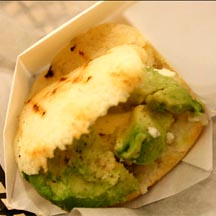
Arepas are a kind of bread made from corn, thicker than tortillas and with a consistency not unlike dense English muffins. Popular with Venezuelans and Columbians, they’re often sliced and stuffed, like a sandwich, with any manner of fillings. Twelve set assemblies line the menu here.

Recommended by the server/cashier, the roasted pork and onion selection ($6.50) brings an arepa filled with succulent swine slices and sweet, yielding caramelized onions. Despite the juiciness of the fillings, on the whole, it’s a teeny bit dry; a few smears of freshly smushed avocado spread from the small silver ramekin does the trick.  

Pickled octopus arepa ($7), otherwise known as the pulpo, sates seafood lovers with its generous, toothsome filling of diced octopus tentacles and mantles, well marinated in citrus and coriander and tumbling out from between the halves of arepa. Our only quip is that the octopus could have self-pickled a while longer for a more tender consistency. 

The daintiest serving of uber-fresh grated coleslaw of carrot, onion, celery and cabbage—refreshing and flavourful—accompanies both. 

Those looking for something more than just a sandwich opt for one of three platters. Pabellon Caraqueño ($10.50) steals the show, with a prettily plated assembly of greaseless fried plantain, basic grilled arepa, soft, cooked black beans (and I mean black!) under a grating of queso blanco, a molded puck of white rice, and the most palate-pleasing serving of savoury and sweet pulled flank steak meat stewed in tomatoes and spices. The cheese is somewhat dry, having been grated much earlier, and the rice is not a hot as it should be, but despite these shortcomings, we are thrilled with the dish. 

The most likely favourite for little ’uns comes in the form of tequeños: freshly baked, airy pastry tubes wrapped around melting white cheese. Avocado dip accompanies the four thumb-sized pieces, but a simple side of salsa cruda (homemade salsa) would have proved a better partner.

High ceilings, blond wood tables, a wall of windows and well-placed lighting make this a bright, open, happy place, while exposed brick walls and original tin ceiling add authenticity. Rows of bright yellow packages of harina decorate one sizeable shelf, their colour echoing the sunny yellow walls in other places. Chefs prepare arepas behind a glass counter as ordered, successfully distracting short attention spans while they wait for orders.  

Mill Street organic beer tempts ale quaffers. And interesting, healthy and freshly prepared juices, like mango and cantaloupe-melon, make good choices to their pint-sized partners—but at a price ($4.50). A glass of lemonade (just $2), a perfect balance of raw sugar cane and fresh lemon juice and topped with mint leaf, promises to be a regular’s favourite. 

Stroller accessible, but bathrooms downstairs. No high chairs. 

Arepa Café, 490 Queen St. West, 416.362.4111

Kelly Jones is a freelance writer and editor of articles, reviews, websites, novels and board games. She teaches Food Writing at George Brown College.

Second meeting slated for ‘food belt’ proposal

0

A second meeting to discuss a controversial plan to establish a Markham “food belt” will take place later this month.

“It is a vision for the future of agriculture, not just in Markham or our region, but in Canada,” said Coun. Erin Shapero. “I think there’s no more important debate than this.”

The joint proposal put forth by Shapero and fellow Thornhill councillor Valerie Burke calls for 16 per cent of Markham’s total lands, roughly 2,000 hectares, to be preserved for agricultural purposes. The land is classified as Class 1 farmland, the best in Canada.

“You can’t get it back,” said Coun. Burke. “It took thousands of years for the soil to develop. We have to look at the big picture. This is about our survival, for heaven’s sake.”

The Town of Markham is currently preparing to revise its official plan to accommodate population growth mandated by the provincial Places to Grow Act and looking into various intensification plans.

“In survey after survey, Markham residents have said do not continue the cycle of sprawl onto farmlands in our north,” Shapero said.

Others, however, are skeptical about the response residents will have to the plan. They argue the proposal will mean that 100 per cent of future growth would come through intensification of existing residential areas.

“I have a hard time believing that the existing ratepayers are in for 100 per cent intensification,” said Stephen Dupuis, head of the Building Industry and Land Development Association, which represents 1,300 companies. He said that the creation of the farm belt could create what was recently dubbed an “apartment belt” in a local advertisement. Shapero dismissed the ad.

“It is fear mongering that you’re hearing from the development community,” she said. “The fact is, they’ve been building cookie-cutter, single-family housing for years and years, and they don’t want to change.” The meeting is scheduled for Feb. 16.

Forest Hill resident to bid on Canwest dailies

0

FORMER SENATOR JERRY Grafstein, a long-time Forest Hill resident, is filing a bid, along with two long-time media professionals, to buy three of Canwest’s daily newspapers.

“There is an urban legend that the future of newspapers is dim. I don’t believe that. That is a view that the glass is half empty. I don’t believe that. I think the glass is half full,” Grafstein said.
 

He is one of the founders of Citytv, and has had a lengthy career in public affairs and law. Grafstein said he will be filing a bid to purchase the Montreal Gazette, the Ottawa Citizen and the National Post with a consortium of colleagues.

Raymond Heard (a media consultant with major corporate clients, a former White House correspondent and managing editor of the Montreal Star and head of Global News) and Beryl Wajsman (editor of Quebec’s largest English language weekly and producer and host of a Montreal radio news magazine program) will be bidding with Grafstein.
 

The vitality of the ownership is based on local direction, Grafstein said.
“You should know the communities you serve,” he said, “as opposed to having distant corporate ownership.”
“We intend to dig deeper roots into each of the communities,” he said.