

Home Blog Page 13

Miriam Baker's rise in the T.O. fashion industry

0

For Miriam Baker, the idea of pursuing a career in fashion was one initially curbed by pragmatism. 

“I always had an interest but never considered it a viable career option because I was thinking more along the lines of traditional professions,” she says.

While in high school at Freemont Academy, Baker struggled to find her footing and her niche. “I think I was just feeling really lost,” she says.

After graduating, Baker worked in retail. It was during this time that she decided to think about what she wanted to do. She eventually landed on fashion.

Finally pursuing her dream, Baker enrolled in George Brown’s fashion techniques and design program. Once finished, she continued her education, attending Ryerson School of Fashion. After graduating in 2013, Baker began her career.

She learned of the Toronto Fashion Incubator’s New Labels competition, where each year emerging talent across the industry compete for TFI’s prestigious Suzanne Rogers Award for Most Promising New Label. Baker decided to take a chance and enter the competition, presenting a collection she had developed during her studies at Ryerson. The collection’s designs were inspired by a wedding she had attended in the English countryside.

“It was on a Victorian estate,” she says. “I think it was nostalgia, the colours and the romance of the countryside that inspired me.”

“If you have your niche and have your vision, you can make it.”

Baker also sought to create clothes to fit and flatter women with larger busts, a group that traditional sizing often doesn’t adequately accommodate.

The judges were inspired by her vision, and after surviving the initial selection process, Baker was  selected to present her collection. 

“It was like [reality TV show] Project Runway,” she says. “They ended up with four designers who showed at the TFI New Labels competition.” Baker was not only one of those four, but won the entire competition.

With her winnings, she was able to join the TFI as a fashion resident with her own studio space. Since then, she has successfully launched her own line but concedes that breaking in to the industry is a difficult task.

“It’s really hard to get meetings with buyers, unless someone makes the introduction for you. It’s a struggle, but if you have your niche and have your vision, you can make it worthwhile.”

Currently Baker operates an online business and launches two collections each year that are available at boutiques such as Tucci Armadio and House of Angelis. 

“It’s different every season,” she says. “Often what inspires me is travel. I’m also very inspired by the fabrics themselves, but it’s always different. Sometimes it’s just a historical period.”

Most recently it was an art nouveau fashion plate painted by Gerda Wegener that she purchased on a trip to Paris.


Women are a growing part of cannabis market

0

After a long day of carefully prepared lunches, attentive homework nagging and the sometimes frantic running to and from soccer practice or dance class, many moms choose to unwind with a nice glass of wine. 

By July 1, 2018, this staple mommy routine has the potential to transform into a sleekly designed vaporizer, a thoughtfully infused edible or a sexy lubricant to treat yourself right.

Pot-smoking moms may become a more culturally available image, and that should not come as a surprise. Women, the new face of the industry, are quickly becoming one of the fastest growing demographics of cannabis consumers and key disruptors in a typically male-dominated marketplace.

Stephanie Karasick is a cannabis enthusiast, mom and pot entrepreneur. She is the co-founder of local company Strainprint, an app that helps patients track their cannabis use. Karasick has been using cannabis to help with post-traumatic stress disorder–related anxiety and depression for the past three years. Her cannabis use, which helps her function better, no doubt “benefits [her] kids” as a result.

“I’ve been completely open with them, throughout my journey of discovering cannabis. They know that it’s medicine, and they see how it helps me.”

However, outside of the intimacy of their private lives, the family has experienced stigma on a regular basis that relates to general cannabis use, as well as  cannabis use as a mom. 

In a space that is rapidly evolving and presenting new challenges, the Karasick family takes these opportunities to educate and engage in meaningful dialogue with their community. 

Another mom and cannabis user, let’s call her Athena, has also mixed the worlds of mom-preneur and pot-preneur. Athena and her partner own a Toronto-based edibles company that currently operates in the illegal space, and she is a mom to three kids ages two, eight and ten.

“This business has provided us with a lot of opportunity to educate our kids,” she says in reference to a time when a nurse had visited her kids’ school to talk about marijuana use and how it was bad. She used this as an opportunity to provide her kids with accurate, honest and useful information. 

For moms out there looking to explore alternative recreational options, the issue of access to cannabis by children and minors is at the forefront. 

Will open and legal consumption of cannabis by parents lead to cannabis being consumed by children and minors? After all, who doesn’t recall sneaking a sip from their parent’s liquor cabinet as a curious teenager?

This concern is also echoed by the cannabis legislation tabled in April of this year, which emphasizes the need to ensure that cannabis is kept out of the hands of children and minors.

One of the main reasons cited by Prime Minister Trudeau for legalizing cannabis is to restrict its access by children and minors as a legal recreational market provides us with greater opportunity to regulate and restrict access.

Part of this regulation and restriction of access by children and minors is driven by an understanding of cannabis and what it means to engage in a new recreational adult culture.

“Understanding the importance of safe and responsible use is vital, as we move forward” says Irie Selkirk, a mother of two, aged four and 10. Selkirk grew up in a cannabis-positive environment.

She uses her experience and cannabis advocacy work to help mothers in Toronto with cannabis uses, as it relates to motherhood. Selkirk is the founder of the Cannamama Collective of East Toronto, a Facebook group that facilitates moms who use cannabis to connect, ask questions, share experiences without judgment or stigma. The group also meets socially once per month and provides a safe space for moms to build a community.

If you’re a mom and thinking about using cannabis, here are some things to keep in mind:

Educate yourself as there are many cannabis varieties and products available and you should know the differences.

Then educate your children. Cannabis will soon be legal, which does not mean that it’s safe for use by children and minors. It’s important to openly speak of the dangers of cannabis on the developing brain.

Be responsible. Whatever your experience with cannabis in the past, start low and go slow. Be sure not to drive while impaired, and be the example of safe and responsible use for your children.

Finally, safety is paramount. Take all necessary precautions to ensure your cannabis is out of reach of your children. Use a locked storage jar or Stashlogix bag. Lock your stash and make sure your children are not able to abuse your new legally obtained cannabis product in your absence.

Richmond Hill man saves three from house fire

0

Domenic Ferrantone was walking to his car at 6:15 a.m. on Saturday, May 6, when he noticed flames across the street creeping up the side of his neighbours’ house on Canyon Hill Road by Elgin Mills Road West and Bathurst Street. At the sight of the fire, he directed his wife to warn the neighbours at the houses adjacent to the fire, and he immediately called 911. And then he ran toward the fire, which was quickly engulfing the front of the house, to wake up his neighbours. 

“They were in bed. As I was knocking, the fire alarm went off,” recalled Ferrantone, who was up early to head in to work at the Eagles Nest Golf Club. 

“The poor lady was half asleep. She thought it was a car alarm. I was just about to kick in the door and she opened the door.” 

He was able to get the three people in the house — a woman and her child and a nanny — out safely. The fire, caused by an electrical spark in the walls, died down at around 9:30 a.m. “We pass that house every day,” said Ferrantone. 

“Even though we don’t really know them, we always wave because we’ve been there for 13 years. They’re my neighbours. You’d want neighbours to help. At the moment, you’d hope everybody would do the same.”

Eat This Minute: T.O.’s newest New York City import has tongues wagging

0

A MISSING PUZZLE PIECE
When three dudes from Egypt arrived in the U. S. A. back in 1990, they noticed something was up. Mohamed Abouelenein, Ahmed Elsaka and Abdelbaset Elsayed opened a hot dog cart at West 53rd Street and 6th Avenue, and found that Muslim cabbies, who made up much of their customer base, weren’t satisfied when it came to halal food options. A trio of great minds thought alike and Manhattan’s original halal food cart concept was born. 

HALAL 101
From Arabic, the term “halal” literally translates into “permissible” and must stick to Islamic law as defined by the Qur’an. This means that when preparing halal meats, the animals must be both healthy and alive at the time of slaughter (although there’s debate surrounding stunning). A dedication — or tasmiya — is uttered before the animals are killed, utilizing specific cuts before the blood is finally drained from the carcass.

KEEP IT COMBO 
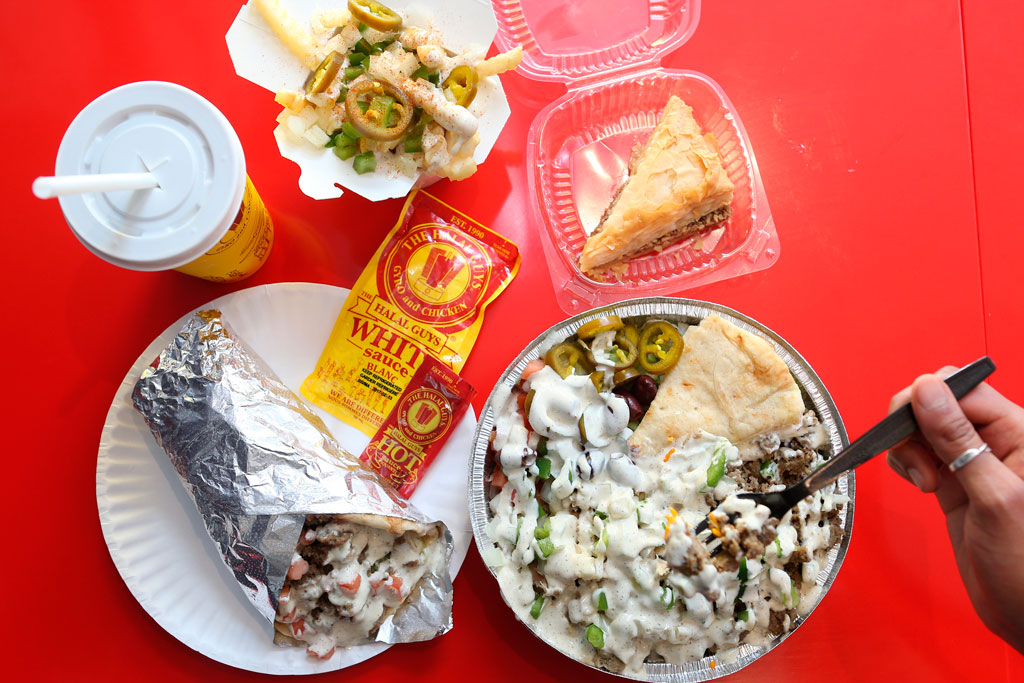
But enough about that. Fast-forward a few years and the Halal Guys has morphed into a halal empire, with almost 50 outposts globally. The chain has recently expanded into Canada, pinpointing Toronto as a red-hot market. With the city’s flagship space, which seats 30, located at Yonge and Wellesley, the New York–style lineups already appear to be here to stay. Inside, bundles of Ryerson students order from the concise menu made up of sandwiches and platters.

The best bet is to get the chicken and beef gyro platter, which is piled high with the fresh-from-the-rotisserie-spit meats, resulting in protein that’s moist and crispy all at once. 

A mound of orange-hued rice, pita triangles for scooping, rounds of jalapeno plus an admittedly lame salad (iceberg and tomato isn’t where it’s at) finish off the plate. Say, “Plenty!” to the inquiry regarding the amount of garlicky mayo-based white sauce desired and show caution when it comes to the red (it’s real fiery, we promise). And don’t worry — if you’ve accidentally undersold yourself on the white sauce, catch the server walking around, as she tops folks up.

The Halal Guys, 563 Yonge St., 416-901-1011 

Work Out with Monika: A kick-butt workout in an uptown park

0

Fit Chicks is a series of boot camps and fitness retreats that began in 2008 when founders Amanda Quinn and Laura Jackson saw a gap in the market for women who wanted to be part of a fitness community.   
Today I’m trying one of their outdoor bootcamp sessions in Willowdale Park with instructor Veronica Morgia.  

WARMING UP 
We started with a dynamic warm-up of five minutes using dynamic movements to get the blood flowing and body warm. 

THE WORKOUT
The exercises are broken into sections, and you do each one for a full minute before moving on. We started with plyometrics, strength and isometric exercises like windmill jumps, squats and static pliés. Then moved into the kick boxing section with squats with front kicks alternating sides, plié hold with speed bag arms, squat side kick right and then left. Then we put our feet together and did uppercuts, jumping jacks with uppercuts and finally jab cross on the right side and then left. Next up was two sections of high intensiy interval training with lunges, push ups and squats. The final drill was a sprint, followed by a jog, and then we did five minutes of abs exercises like the plank, lower leg lifts and side plank with hip taps. 

LEVEL OF DIFFICULTY 
This was really challenging. Each exercise is repeated for one minute and your legs will be screaming at you to move on to the next. 

DURING THE WORKOUT
I loved the fact that we were working out in the open. The monotony of the gym has always bored me. This bootcamp is perfect for the anti-gym person who needs external motivation. And when you’re part of the program, the workout changes each night, so you keep it fresh and your body guessing. It was a killer sweat session.

THE NEXT DAY 
The workouts are all designed with a total body workout in mind, and that’s exactly what I got. I felt it the most in my lower body the next day. The lower body was utilized during the cardio movements and the strength exercises. 

FAVOURITE PART 
Fit Chicks gives you the feeling of having a personal trainer with the camaraderie of a group class. Veronica Morgia pushed me to do more than I normally would do on my own, which is key to seeing changes in your body. 

ROUND TWO
This is something I could definitely get into and would try again. It’s challenging and affordable because they use outdoor parks for their workouts or rent spaces in community centres, school gyms and churches in the colder months.

Temple vs. townhouses

0

A new development proposal for 52 townhouses on the eastern border of the Hindu Temple Society of Richmond Hill has the local community on edge. Built in 1983, this place of worship has become a destination for thousands of visitors annually, with ceremonial events and celebrations. The development is currently in the planning process with the Town of Richmond Hill. 

Among the Temple community’s requests are a buffer zone between the houses and the temple, a tree line and a road to divide their properties. “We want to be in peaceful coexistence with whoever our neighbour is,” said R. K. Moorthy, president of the Hindu Temple Society. “But we want our neighbours to respect our way of worship.”

Homes: Take back your backyard

0

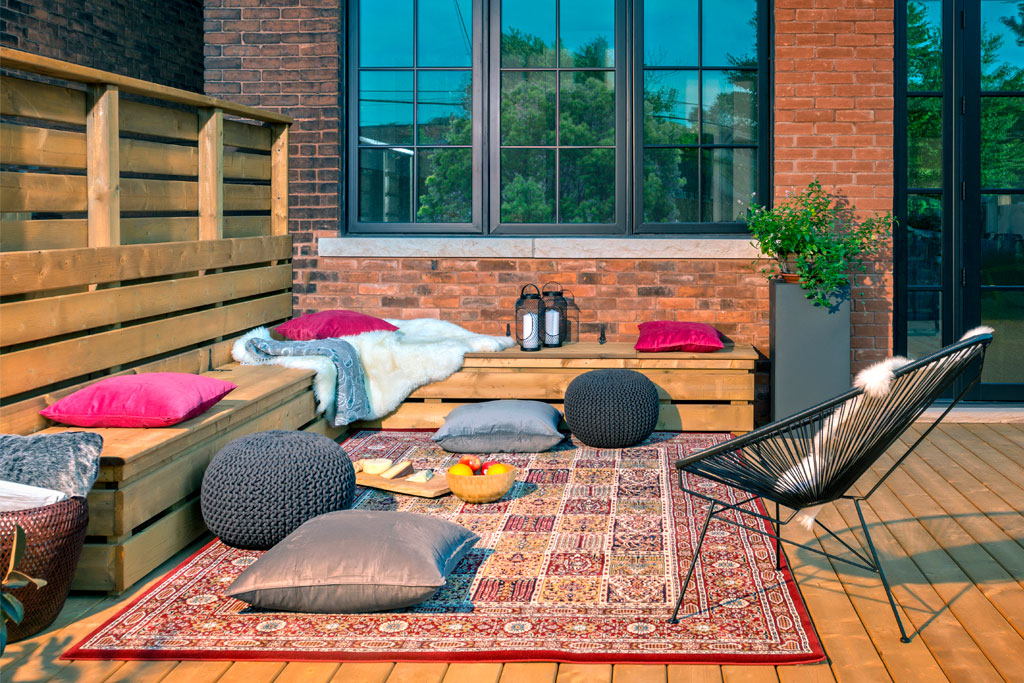
With urban neighbourhoods getting denser, backyard privacy is becoming more important and harder to achieve for homeowners. The good news is there are easy solutions to enhance backyard privacy.

Plants: Regardless of whether you’re working with a large urban backyard or a smaller downtown plot, adding some low-maintenance greenery can optimize privacy, while adding some visual appeal. Alternatively, you can plant tall grass in raised planters, which create a nice blind while allowing the wind to pass through easily.

If greenery isn’t enough, buy fast-growing trees that work with your backyard location, which can offer privacy and shade. You can also use shade canopies for extra coverage as they can mount to three stationary points to create a great UV blocker. 

Pergolas: Overhead privacy structures and pergolas provide endless possibilities to add style, privacy and shade to your backyard. It’s a great outdoor investment that also increases the value of your property much like a deck would. It also creates the sense of an outdoor room, framing the space and making it more inviting since it gives you a little more privacy.

To add personality, plant climbing vines to gradually colonize the structure for a natural, soothing canopy. And try trailing fashionable vintage lights or lanterns to bring a touch of the indoors outside.

Horizontal privacy: Horizontal or woven privacy screens are also a great esthetic addition that can help create that separation in your backyard from neighbours. They also provide seclusion and a cool lounge feel to any outdoor space.

Many of my clients are looking to build more sustainably and are more aware of the ecological impact of certain materials.

An industry secret is MicroPro Sienna, which is an eco-friendly pressure-treated wood that’s affordable and only about half the price of cedar. I always remind my clients to protect their outdoor investments: once your Sienna project is complete, apply a water repellent finish to protect the wood.

Upcycling: I’m a big fan of transforming unwanted old furniture or doors into unique outdoor accents. You can easily make over a vintage door into a privacy wall to add a personal and vintage touch. A fun and affordable project that also reduces our carbon footprint!

Furniture and accessories: Brighten up shady corners with vivid jewel tones, shades and vibrant patterns. If your backyard feels like you’re on vacation, then every time you step outside will be as invigorating as a holiday. Feel refreshed with sunshine yellow bistro chairs, bright blue accessories and modern white tables to entertain your family and friends behind colourful, multi-tasking privacy curtains. With summer heating up, privacy curtains add some much-needed shade to your beautiful backyard space, making it the ideal place to cool down and relax this summer.

Chris Palmer is a regular guest expert on the Global Morning Show and is the owner of Handcrafted by Chris Palmer. 

Shop Talk: The city’s hautest fashion influencers

0

NAME: HAWLEY DUNBAR
BLOG: SIDEWALK HUSTLE
INSTAGRAM: 156 K followers

One half of powerhouse brand Sidewalk Hustle, Dunbar is known for her edgy-chic street style and eye for footwear. 

What shoe are you really feeling this season?
I’m all about flatforms and sneakers. Flatforms are so easy to rock with nearly anything, almost as much as sneakers. You can make waves by tossing on a fun sock too. 

Any amazing recent finds from a Toronto designer?
I’ve been obsessing over this new polka-dot choker from Biko. It gives this great edge to every single look.

How do you plan on dressing at festivals?
It’s the one time of year anything goes (except floral crowns #HardNo). You’ll see me in looks that are likely bright, patterned and possibly metallic. 

NAME: JAY STRUT
BLOG: JAY STRUT
INSTAGRAM: 57.5 K followers

Known for his outré style, Strut is a fixture in fashion scenes in Toronto and abroad, hanging with Donatella Versace et al.

Current go-to piece for summer dressing?
My go-to piece is my scissors for sure! I cut and crop everything when the weather starts getting like this!

How do you plan on dressing at festivals?
It’s going to be all about the glam — makeup that is! 

What shoe are you really feeling this season?
I’m torn between the Balenciaga thigh-high Knife boots and the Yeezy Season 4 knit ankle boots! #HELP.

What trend shan’t be gracing your bod?
Please don’t come at me with a man romper! 

NAME: ALYSSA GARRISON
BLOG: RANDOM ACTS OF PASTEL
INSTAGRAM: 64.8 K followers

Noted style blogger Garrison can be spotted thanks to her pastel pixie esthetic dusted with a pinch of quirk.

What’s your essential summer accessory? 
A teeny tiny colourful backpack for cycling around the city. Currently obsessed with every custom-embroidered bag that Stojka makes.

Any amazing recent finds from a Toronto boutique? 
LoversLand always has an amazing selection of sexy little dresses, and their stock at the moment is no exception.

What shoe are you really feeling this season?
Mules! Specifically metallic, embellished and fun coloured mules. They’re comfortable and look good with almost any outfit you can dream up. 

Construction beside John Fisher P.S. to begin this summer

0

The developer of a 35-storey tower proposed for next door to John Fisher Junior Public School has reached an agreement with the Toronto District School Board (TDSB) that will allow construction to begin this summer. But parents argue certain elements of the recent risk assessment have been ignored.

“The parents are very concerned that the TDSB … is watering down the clear recommendations of the risk assessment to justify their pre-determined outcome,” said Etienne de Villiers, a parent whose child attends the school.

The risks identified in the assessment by Environmental Consulting Occupational Health (ECOH) include diesel exhaust, air quality, noise, traffic and fire. 

At a public meeting on May 3, Om Malik, CEO of ECOH, said the assessment also took learning hazards into account.

“Small children are more vulnerable to certain risks. They are developing. Their health and safety is not only affected, but [also] their attention span and their learning environment,” he said.

ECOH recommended 14 measures to mitigate risks related to the construction, which include the hiring of a credible third party to monitor construction each day. If a third party is not on site daily, the assessment stated the risk would fall within an unacceptable range and ECOH would not recommend occupancy of the school during construction. Although ECOH found the mitigation measures proposed in the new agreement to be acceptable, De Villiers claims the language leaves too much room for interpretation.

“The agreement has a TDSB third party monitor the site ‘as frequently’ as daily,” he said. “They could attend one time only with the language that was adopted.”

As part of the agreement, the developer KG Group will erect a 12-foot hoarding wall between the construction site and the school before excavation; use safety netting; and install double-height guards across building openings.

The TDSB will also put some of its own safety measures in place. 

Angelos Bacopoulos, associate director of facilities with the TDSB, said the playground will be moved to the east end of the school, and the windows on the west side of the building will be replaced by the fall of 2017. The TDSB will also put up a second hoarding wall between the site and school.

The TDSB board approved the plan on May 24.

In the meantime, parents must decide if their children will attend the school next year. De Villiers, for one, said his child will not be returning.

When kid-sick is the new homesick

0

Parenting news these days is about how to get your kids ready for camp, how to know if they’re ready and what to pack. You know that already. But how about getting parents ready for camp?

We all understand that sending a child to camp is a huge developmental challenge for them. Leaving home for the first time to go away without their family calls on them to grow and stretch, to tolerate sadness and make it through the homesick blues. We know that’s normal. We’re psych-savvy, so we know to normalize homesickness and tell them it happens to most new campers (and some not-so-new), and they’ll get through it.

But who does that for us? The bad news is that my kids are 31 and 28, and I still get worried and kid-sick when they’re far away. The good news is that I always know that this too shall pass.

It is inherent for parents to worry when we give over our children into the hands of others for many days (and nights!!) on end. This is in our DNA. It kicked in when our kids were born and it never goes away. Mama and Papa Bear are alive and stalking. They are us. And they get hellishly provoked when we send our kids to camp. We can’t help worrying when our kids leave home, beyond our control.

This is not the interesting part. The interesting (and important) question is what we do in response to these out-of-control feelings. Our first impulse is to share them, because we’re an oversharing generation. Sharing them with our kids can be direct but is more likely indirect. Probably you know enough not to share any of your own unpleasant summer camp experiences with your kids … like your horrible homesickness … or how cold the lake was … or the bad counsellor … or the awful cabin mate(s).

The more confusing oversharing is the overidentification we all do with our kids. You’ll know you’re overidentifying if you hear yourself saying the words: “We’re going to camp … this summer.” You’ll also know it if, when your child expresses trepidation about going to camp, you start to get uptight.

The trick here (and I’m not saying it’s easy) is to work to separate your child’s feelings from your own. As a parent, I find that affirmations help a lot. Cheesy but true. It goes like this: my 31-year-old daughter leaves my house after dark on her bike, and I get scared. My impulse is to ask if she has her lights and her fluorescent vest and tell her to call me when she gets home. When I’m good, I take a deep breath (this part is important) and use an affirmation: I say to myself: “She is going to be fine. This is my fear talking. It’s not helpful.” And then I tell her I love her and kiss her goodbye.

Transpose that into your child talking about camp fears. Kids are super smart. They can tell when they express a fear and we share it, even silently. So buck up and work on deciding to believe that your child will be fine at camp. You chose the camp carefully. You trust the directors to get it mostly right. Key word: mostly. 

There will be skinned knees and bruised egos at summer camp, just like in the real world. This is not preventable, and nor is it desirable to prevent. Because of the blessings of the skinned knee. Which will send you home a child who is more resilient.

So your job is to communicate to your child that you have 100 per cent confidence that they can manage at camp, even when there are challenges. This message will infect them with confidence. Believing in their competence matters enormously. If you step in too much, it telegraphs that you don’t have faith in their ability to manage.

What can you do with your worries? Don’t bury them; that’s not usually helpful. Talk to other parents going through the same thing. Seek adult support. That will help avoid leaking worry to your camper.

Also, what’s going to happen to you when they’re gone? That’s harder. If your life up till now has been focused almost entirely on this child who is now leaving you, it’s time to attend to you. Because summer camp is a rehearsal for when they leave for university. It’s also a rehearsal for when the storms of adolescence cause them to separate from you: usually not tidily or pleasantly.

None of this is easy. The emotional umbilical cord lives forever in our hearts.

Rarely does a ballet begin in a mental institution

0

For every Nutcracker and Cinderella, the National Ballet of Canada offers the flipside of the tutu coin. This month, it’s the Canadian premiere of the explosive ballet A Streetcar Named Desire, choreographed by John Neumeier. A production that could come with its own warning for graphic subject matter.

The ballet, based on the Tennessee Williams’ play, features Jurgita Dronina, Svetlana Lunkina and Sonia Rodriguez dancing the role of Blanche DuBois.

It opens where the play ends, with Blanche in a mental institution. Through her character, different aspects of the story are revealed through a series of flashbacks.

“In his [John Neumeier’s] ballets, it is an impression of what the play is for him,” says Rodriguez.

“It’s not like watching the play. It’s his version of that, his imprint. The whole ballet is through Blanche’s eyes.”

With the ballet, because the focus is on Blanche, there is a back story to her life we don’t get in the play.

“You do have some idea who she is and where she comes from,” says Rodriguez. “There is a lot more depth to what her life was like and how she got to be who she is when the play starts.”

Rodriguez was born in Toronto and as a child moved to Madrid, Spain, where she first learned to dance. She joined the National Ballet of Canada in 1990 and was promoted to principal dancer in 2000. She lives in Forest Hill with her husband Kurt Browning and family.

One of the reasons she was excited to set to work on A Streetcar Named Desire was the opportunity to work with American choreographer John Neumeier, recently awarded the Prix de Lausanne Life Achievement Award.

“He’s one of my favourite of all time,” Rodriguez explains. “I tend to always hope to be in his ballets when we get a chance to have him.”

What the ballet offers dancers is the opportunity to hone their dramatic chops. It’s not just about physical movements. It’s also about conveying some serious emotion.

“What’s wonderful about working with ballets that John has choreographed is that there is always meaning and a reason for every single step and movement that you do,” she explains. “Any action, any step, any gesture, it comes from an emotional place. There is always an intent before you even move.”

One might think there is some risk to adapting a story with names such as Marlon Brando and Vivien Leigh firmly attached to its history. 

But given the nature of the story and how it unfolds differently in the ballet, audiences should be open minded.

“It’s not a copy. It is different and it’s about her experiences,” Rodriguez says. “He could have picked another character with the same story, and it would be a very different ballet.”

The play is divided into two acts, one more nostalgic, the second, when the story shifts to New Orleans, Rodriguez describes as “more hectic and distorted.”

She also says the ballet is “very graphic,” suggesting that the company is likely to issue a warning for younger audiences.

“The play is very raw, and he did not hold back at all with any of the subject matter,” says Rodriguez. 

“It is a very explicit and graphic ballet, so that is something to keep in mind. There are some shocking scenes happening.”

A Streetcar Named Desire runs June 3 to 10 at the Four Seasons Centre for the Performing Arts.

From Piano Piano to the Cancan

0

Two years ago, Victor Barry and his wife, Nikki Leigh McKean, promised each other to not open a new restaurant for at least a year. It was a difficult proposition for a chef still glowing from his latest venture — transforming the fine dining restaurant Splendido into the wildly successful Italian eatery Piano Piano. But when the Harbord Room closed in October 2016 and the space went up for sale, Barry couldn’t resist temptation.

“My wife and I started dating at the Harbord Room,” Barry says. “It has a huge history, not only with us, but with so many people in Toronto, and I just couldn’t get it out of my mind.”

Barry and McKean, along with Piano Piano co-owner Brendan Piunno, had finally transformed their Italian eatery into well-oiled machine. The number of meals served has grown from 180 to more than 280 on the busiest evenings, and the restaurant has earned spots on “best of” lists along the way. The married couple also had the important duty of raising their toddler-aged children, Sofie and Charlotte, on their busy plate. 

But the three business partners  jumped at the chance and purchased the space, beginning renos to transform it into a casual French diner named Café Cancan. 

Barry’s dedication in the kitchen dates back to the age of 11, when he spent weekends at his uncle’s Niagara Falls pizzeria. (“It was probably illegal,” Barry says, joking.) He then found work at the Prince of Wales Hotel as a co-op student, which segued into a full-time position after graduation.

There, Barry excelled, developing an impressive work ethic that saw him rapidly ascend the Prince of Wales’s culinary totem pole. On days off, he’d head into the restaurant to learn how to clean fish. 

“At 17 years old, I was working the fish station, which people were just livid about,” Barry recalls. “I was cooking food that I should never have been cooking at that time in my career.”

Following the departure of a trusted mentor at the Prince of Wales, Barry moved to southwest England’s Gidleigh Park, equipped with a ruthless dedication needed to survive in the two Michelin–starred restaurant. 

“Everyone was willing to cut the legs out underneath you to get ahead,” he recalls. “I learned discipline, and it built an incredible amount of character in me.”

After two years in England, Barry moved out west before joining T.O.’s Splendido as an assistant pastry chef. But his first stint was short-lived. Frustrated by the kitchen dynamics, Barry shipped off to Bermuda, where he worked as the sous chef of the Waterloo House Hotel. 

It was there that Barry prepared a life-changing meal for his vacationing former Splendido boss, David Lee. “I cooked him dinner, and the next day, he offered me the chef de cuisine job at Splendido,” Barry says. “Then I bought the restaurant in 2009.”

“I truly believe that the best cheese on a cheeseburger is American.”

Under the cloud of the financial crisis, Barry downscaled Splendido to a stylish trattoria. But the allure of fine dining nagged, and he found himself returning to $180-a-head tasting menus replete with half ounces of caviar, king crab and foie gras.

“We worked really hard for two years and became the fifth best restaurant in the country,” he says.

But the stress of running a high-end restaurant was piled atop a slew of changes in his personal life since taking ownership. Barry and McKean had two daughters, his father passed away and McKean was diagnosed with cancer. Something had to give. So Barry closed Splendido on New Year’s Eve 2015 and reopened with much trepidation as a mid-range Italian restaurant a few months later.

“It’s quite incredible how busy we’ve been and the positive press that we’ve had,” says Barry.

This time around, Barry calmly approaches Café Cancan’s early summer opening date.

“I’m more confident with Café Cancan than I was with Piano Piano,” Barry says. 

Following Piano Piano’s formula of classics “done right,” Barry hopes his new restaurant will achieve similar success. On Cancan’s menu, diners can expect reinterpretations of French staples like rib-eye steak and trout sorrel. His eyes widen with excitement as he describes the spatchcock chicken, cooked in a wood-burning oven and topped with a ginger-vanilla jus de roti.

Alongside these refined menu options, Barry has made a few deliberate additions to remind guests that Cancan, which will open at 10 a.m., isn’t Splendido 2.0. 

“It will be a café where you can grab a coffee and a croissant,” he says. “We’ll have classic French baguette sandwiches for lunch, and there will be eggs on the menu all day long.”

Notably, Barry will offer a double-patty cheeseburger with none other than an oozy square of fromage American in its centre.

“I truly believe that the best cheese on a cheeseburger is an American cheese slice,” Barry says.

Processed cheese and all-day eggs will leave Barry’s Splendido-era fans aghast, much as Piano Piano’s pizzas and pastas did at first. With Café Cancan, T.O.’s fine dining champion cedes yet again for the modest mid-range. But he’s found a sweet spot, balancing well-made food with affordability.

“It’s important to me that people feel like they can have a really good time and not worry about how much it’s going to cost them.”