
Home Blog Page 196

Green P sells 1,000-car Yorkville lot to developer

0

The Toronto Parking Authority (TPA) has capitalized on the value of a prime piece of land in the heart of Yorkville. When the city agency put out a request for bids for the Green P located at 37 Yorkville Ave. and 50 Cumberland St., it secured a deal worth $76 million.

Last month, Toronto City Council approved the sale of the nine-level municipal parking lot to MUC Properties Inc., a subsidiary of Minto. The developer will pay $44 million in cash and construct an 800-space public parking garage below grade, worth approximately $32 million (or $40,000 per space).

In exchange, Minto will get the “air rights” to build above grade. But the deal stipulates that the developer will have to go through the standard planning application process.

Minto is entertaining the idea of a mixed-use development that would include two condo towers. A 400-space private parking garage will be constructed to accommodate residents of the new development.

Neighbouring developments provide some indication as to what might be permitted on the site. To the north is the new Four Seasons Hotel and Private Residences, featuring 30- and 46-storey towers. To the south, at 2 Bloor St. W., is a planned development of 36- and 48-storey towers.

John Caliendo, co-president of the ABC Residents’ Association, said the deal looks good from a financial standpoint.

“The negative is we’re going to undoubtedly get a ton of density there to justify the price,” Caliendo said. It’s not so much that his group is saying it doesn’t want another tall building, so much as it has concerns about what it sees as ad hoc planning in the area.

With dense development the norm in this neighbourhood, the attention turns to parking, which is already at a premium in the city.

Coun. Kristyn Wong-Tam said she was alarmed when she first heard about the loss of parking at the busy lot, both temporarily during the construction phase and permanently through a reduction in the number of public spaces. Currently, the lot can accommodate up to 1,036 vehicles. But, as she understands it, the Toronto Parking Authority (TPA) would have had to undertake repairs of the parking lot — built to its current form in 1973 — regardless of the sale.

Gwyn Thomas, president of the TPA, confirmed that his agency initiated the process when the structure was found to be in need of substantial capital investment. It was declared surplus, and a request for proposals was issued.

“What we’ve done is taken a project that was potentially a $30 million liability to us and turned it into a $44 million asset,” Thomas said.

In a report to city council, the TPA found that the current parking structure does not fill to capacity, even on peak days.

As such, Thomas thinks that the new public parking garage will continue to meet the neighbourhood’s needs. Council has, however, required him to report back on a parking strategy for the construction phase, at the request of Wong-Tam.

Briar de Lange, executive director of the Bloor-Yorkville BIA, said the sale didn’t come as a shock.

“We’ve heard rumblings about it for quite some time, and the value of the real estate in the area continues to escalate, so it’s always quite a draw for developers,” she said.

De Lange echoed Wong-Tam’s concerns about the temporary loss of parking. The Green P contains more than 1,000 of Yorkville’s 7,000 parking spaces. Plus, it’s the most centrally located lot.

Joel Carman, owner of Over the Rainbow, said that the amount of development activity happening all at once in Yorkville is extremely disconcerting.

“There’s constant impact when you have cranes blocking streets and you have dump trucks lined up to excavate,” Carman said. “There’s been a mass disruption of business in the area, and it’s just beginning.”

With the sale slated to close in 2015, it may be a while yet before Minto submits a formal planning application. Minto did not respond to a request for an interview before press time.

Police officer stabbed during routine traffic stop

0

A suspect believed to have stabbed a Toronto police officer in the neck during a routine traffic stop in North York has died. Const. Jeff Blair was stabbed in the neck during a traffic stop near Bathurst Street and Highway 401 last month. The suspect, a 38-year-old male, was shot by police, and succumbed to his injuries in hospital. Blair was rushed to Sunnybrook Hospital, where he underwent surgery, and is currently recovering, explained the chief of police, William Blair (no relation).

“We received a call that I think everyone in our service and the people of Toronto always fear,” Blair said. “A police officer had been very badly injured in North York. He received a very serious stab wound to the neck.”

An off-duty firefighter and Emergency Medical Services came to the aid of Const. Blair.

According to the CBC, the now-deceased male suspect served a sentence for drug trafficking. The Special Investigations Unit — the arm’s-length agency that investigates when police have been involved in allegations of death, injury or sexual assault — has launched an investigation.

One song for Canada

0

Thousands of voices singing in unison from coast to coast is certainly one way to get a message across.

Since 2005, the Coalition for Music Education has organized the Music Monday campaign. The annual event is held on the first Monday of May, in which groups across Canada simultaneously sing the same song to raise awareness for music education programs. Last year, more than 1,700 schools took part. This year, Toronto will be adding at least one more to the list, thanks to one little person proving he can make a big difference.

Ten-year-old Graeme Hambleton, a Grade 5 student at Sunnybrook School, first discovered Music Monday back in February. Motivated by his passion for music, he stood up in front of his school with a PowerPoint presentation in tow, preaching the benefits of music education and asking Sunnybrook to participate in the campaign.

“[Music] can help with social and brain development, and it is a great hobby,” Hambleton says.

In his presentation, he focused on “what Music Monday is, why we are doing it and how music is important.”

“He really inspired us,” says Sunnybrook’s vice-principal, Teralee Johnston. “It was really nice to see him have such passion and to really care about something and then to present it to our community.”

Students at Sunnybrook have been practising “Tomorrow is Coming,” a song written specifically for the campaign by Canadian singer-songwriter Luke Doucet. The students will sing the song at exactly 1 p.m. EST on May 7, while the rest of the country does the same simultaneously.

Thanks to Graeme’s initiative, Sunnybrook’s first Music Monday will be far from an ordinary assembly. The students will have the opportunity to sing along with guest performers such as Ron Sexsmith, Marisa McIntyre and others who are supporting the campaign. They will each sing a song and speak briefly about starting out in music.

The event is also a fundraiser — each child will bring a loonie to the assembly, and local and music industry businesses have been invited to match the money the students raise. All profits will be donated to the Regent Park School of Music, a not-for-profit music school that provides affordable music education for at-risk children.

“I benefitted from the incredible music programs that existed in this province, and they’ve been cut back severely — [they’re] actually really crucial,” says Fergus Hambleton, Graeme’s father, a Juno Award–winning musician who is also Graeme’s inspiration. Michael Ruffolo, Sunnybrook’s music teacher, firmly believes that music is a vital part of children’s education.

“Research shows that music education and music [are examples of] the most effective ways to develop skills,” Ruffolo says. “It furthers lateral thinking, it’s very logical and even math based …We’re really talking about things like fractions and ratios.”

Michelle Garlough, the co-founder of the Amici Music School in Toronto, says the benefits of introducing music to young children are invaluable. She adds it can develop with cognitive skills, hand-eye co-ordination, rhythm and speech and can also help children who have learning disabilities or can’t focus.

The Amici School of Music is currently finishing the first year of its Music Together program — where babies as young as six months are able to participate in music classes with their parents.

“Music is a really great source of expression for kids, and it helps with their confidence. Kids are our future, and I think that it’s important that we nurture all of their learning,” Garlough says.

However, not all children have access to quality music education programs.

Despite being influenced by some of her own music teachers as a child, Garlough says there weren’t a lot of opportunities while she was in high school because music wasn’t considered as important as other subjects like math or science.

“A lot of the time when cuts are made in schools, it often goes to arts programs first.”

According to the Canadian music education charity, MusiCounts, a 2010 national survey of over 1,200 schools reported that music is often the first “frill” to be cut.

But with ambitious children like Graeme, campaigns such as Music Monday have the potential to change the future of music education for generations to come.

Though he graduates from Sunnybrook in a year, Graeme says he would like to see the Music Monday campaign as something that the school will continue to celebrate for years to come.

“I hope they’ll keep on doing it,” he says. “[Music] gets people together.”

905er to compete in Canada’s Got Talent finals

0

At first glance, Shale Wagman seems like any other kid his age. But put him on a stage, and you’ll see just why the extraordinary Thornhill youngster has captured the hearts of Canadian audiences.

The 11-year-old dancer’s graceful and controlled movements have helped him climb the ranks to the finals of the reality television show Canada’s Got Talent. He faces competitors more than three times his age vying for first place.

He said it was quite the shock.

“I didn’t think I was going to be the finalist,” Wagman said. “And then I heard I got the most votes, and I was so surprised. It felt like heaven.”

Wagman first started dancing at the age of five, after his mother enrolled him at Vlad’s Dance Company, near Elgin Mills Road and Bayview Avenue. He was competing solo by the age of seven.

Now, he’s practising 32 hours a week for the final round.

Thanks to support from his family, friends and dance colleagues, Wagman was advanced to the national semifinals following a unanimous decision from the show’s judges.

And if he wins? He will use the money to fund his dream of going to Julliard School, the famed New York performing arts school and conservatory.

But first, Wagman will have to beat out the other finalists, including a Toronto beatboxer, Scott Jackson. Also competing is country crooner Ivan Daigle and an opera singer, Emilio Fina.

The winner of Canada’s Got Talent’s first season will be announced on May 14.

To read or not to read?

0

I learned this one the hard way. One time (OK, maybe more than once) I snuck into my daughter’s room when she was at school, and I read her diary.

It wasn’t pretty.

I read about her thinking and feeling stuff that made me worry more about her, and that put me between a rock and a hard place. Do you go to your child and say: “Hey honey, when I was browsing through your diary the other day, I found out.…” Kind of a problematic conversation starter. If the stuff you find out, by whatever means, includes info that your child is contemplating harming herself, all bets are off privacy-wise. No child has a right to confidentiality if self-harm is on their radar.

If you have no prior reason to believe your child is in danger of self-harm, think — before you read — about how much damage you’d do to the trust in your relationship if you talk to them about something you violated their privacy to discover.

Absent self-harm, how much privacy do they have a right to, and should you read their diary? To make this question a little tougher, let’s lump in Facebook with their diary. By which I mean that most kids today use their Facebook page, pics and profile as their diary. You want to know what they’re posting, just like I wanted to know what was in that diary. This is a natural parental urge, just like the urge we all have to control everything they do and keep them safe for every nano-second of their lives.

But like many other “natural” urges, this one has to be resisted. It’s like the story of my daughter and the bicycle. When she was in university and living downtown a few years ago, she would come home for dinner and then ride her bike back downtown afterwards. I would make her phone me when she arrived safely. She’d say (correctly): “Mummy, I ride my bike all over town every other night and you don’t make me phone you when I get home.”

She was right, and the reason had to do with boundaries. Get some of those. They’ve been both difficult to acquire and very helpful to my relationship with my kids as they grew through adolescence.

Boundaries are what give you the distance that allows you not to make her phone you every night when she gets home, if she’s in university. As parents, our tendency is to hover. (They don’t call us helicopters for nothing.) And it’s harder to hover from a distance.

Committing to taking a little distance allows us to stop and think before we go snooping in their drawers and on their computer, and the snooping is not good. Don’t let yourself walk into the room and look for the diary. Resist that “natural parental urge.” Use your impulse control. And when your kid un-friends you on Facebook, let it go. Yes, for sure she’s un-friending you ’cause she’s posting stuff she doesn’t want you to see. And that’s something you have to let go, as part of the process of letting your child go — based on the understanding that, unpleasant as it is for us, their growth requires our letting go — and trusting that we’ve raised them well and they are on their way to learning how to make good choices for themselves, with a few bad ones thrown in to help them learn from experience.

That placing of distance between us and them is a required part of growing up — for kids. The core task of adolescence is to individuate and separate from parents, to find their own self, separate and independent from us, and to do that, they need some boundaries around their mental, physical and social space. So paws off that diary.

Gold medal medicine

0

Dr. Bruce Kidd was a member of the 1964 Canadian Olympic team and is a professor in the University of Toronto’s faculty of kinesiology and physical education. A documentary film, called The Runner, was produced about his life.

What’s been your most profound Olympic moment?
I would say, at this point in my life, rhyme off the number of encounters I’ve had where, in this diverse and sometimes divided world, sport and particularly the Olympics brought people together for a conversation.

There has been talk of yoga’s inclusion as a sport in the future. Thoughts?
Yoga is a wonderful form of physical activity, but I don’t see it as a competitive sport. There are many forms, and it is almost like a religion … but as a competitive sport in the Olympics, I just do not see that.

Do you support the Own the Podium program?
I have a nuanced opinion. I love the idea that Canadians should try to be the very best we can be, and I love the ambition that is captured in Own the Podium, but I was very upset with that as a slogan for Vancouver hosting the Olympics. You know, it is like inviting people to your house with the slogan “I’m going to beat the s**t out of you” — very unwelcoming, very contrary to the Olympic spirit. I welcome ambition, but the Olympics is about affirming the effort of everyone. To single out only those that make the podium is contrary to the Olympic spirit.

I get the feeling we don’t produce our fair share of elite athletes. Is it just me?
You know, Ontario used to lead the Canadian system. Now we are in a hole because of 30 or 40 years of neglect and bad decisions. Facilities and grassroots programs have fallen behind and athletes now go elsewhere to train. There are certainly very good people in Queen’s Park, and the Pan Am bid is part of the effort to change that … but just as the economic leadership has shifted to Western Canada, so has sports leadership — to the west, I’d say, and Quebec.

Why are we becoming a nation of couch potatoes?
My sense is that it is not a single pattern [behind the trend]. A dismaying level of inactivity among children and youth has been documented … but certainly many are very active in sport and other forms of physical activity, as are many adults. The headline is that, yes, there is a crisis of physical inactivity that has contributed to a frightening increase in non-communicable diseases [such as diabetes]. What’s interesting is that if you walk, cycle, drive around Toronto, you see runners.… The overall pattern is the alarming one, but beneath that, there are some very encouraging signs.

So what caused this mess?
You know, there is a combination of factors. You can point to worldwide trends and you can point to Ontario’s and Toronto’s specific factors.

Should we, as parents, be pressuring schools, local officials?
Yes, but you also should be doing stuff with your kids. There is a powerful correlation: if the parents are physically active, so are the kids. Sometimes kids get parents [active], sometimes it is the other way around, but active families tend to be more healthy families.

What do you do to keep in shape? Do you still run a lot?
I don’t run. I have some injuries that persist. I cycle or walk. In the winter, I cross-country ski or snowshoe every day, and I do Pilates twice a week and some strength fitness with small weights. I do something every day.

How do you get addicted to exercise and develop an overall fitness habit?
I would say, think about something you’d like to do: manageable and gives you a sense of satisfaction and pleasure, and find someone to show you the ropes and do it with. The sociability side, the friendship side is really important … number one factor in women’s running — the women’s groups that run around the city.… As a runner, in earlier times, the men’s networks I was part of — it really helps during the rough periods to have someone to talk to: how they dealt with the small nagging stuff, like plantar warts.

What do you think of Rob Ford’s Great Waist Challenge?
Well, I wish him luck in it. I mean, I commend him for his honesty in recognizing that the extra weight he is carrying is both a health risk to himself and a very bad example for people in Toronto.

Suzuki and Strombo team up

0

We Canadians love the wilderness. Whether we’re talking to visitors here or people we meet in our travels, our conversations almost always end up about our great outdoors. Caring about the environment is one of the ways we define ourselves. But how good are we at protecting it?

Despite national parks that act as natural wildlife reserves and bold policies adopted by some of our most progressive provinces to combat climate change, our environmental regulatory system is being downgraded by a federal government that gives some industrial interests priority over the environment.

The federal government recently signalled its intention to gut the Fisheries Act by stripping down habitat protection provisions, and it plans to amend the Canadian Environmental Assessment Act (CEAA) in a way that would make it easier for mining and oil companies, for example, to jump through regulatory hoops and get projects up and running faster than the time required to evaluate all their impacts on nature.

These legislative changes could have serious repercussions for the health of marine environments, including the Gulf of St. Lawrence. Softening environ-mental laws could have a direct impact on the Gulf’s health and future by allowing the oil industry to have access to this fragile and complex ecosystem.

I had the chance to visit the Magdalen Islands, in the heart of the Gulf of St. Lawrence, in spring 2011 with my friend George Stroumboulopoulos. We were filming a web segment to raise awareness of the Gulf’s importance and of the risks associated with oil and gas drilling. The natural beauty there so inspired me that I wrote “The Declaration of the Defenders of the Gulf.” It’s a call to slow down and consider the values of nature and the importance of the area to the people who have lived there for generations and, indeed, to all of us. Now is the time to defend one of the planet’s most precious and unique ecosystems.

There’s been a lot of buzz around possible oil and gas development in the Gulf, including a proposal to drill in the Old Harry area. The stakes are high. According to the Quebec government, the Old Harry prospect is twice the size of the Hibernia oil field, with about two billion barrels of oil and up to five trillion cubic feet of natural gas.

We must reflect on the long-term impacts of industrial development — from an environmental perspective and in consideration of the communities that have depended on the Gulf’s bountiful resources for thousands of years.

Scientists say we need to know more about the Gulf’s ecosystems and the complex relationships people have developed with them over millennia. That’s why we must invest in science-based research and strengthen our knowledge before doing anything that could jeopardize the health of the Gulf’s ecosystems. The Fisheries Act and the CEAA are based on sound scientific information. It is of utmost importance that any changes to these laws be informed by the same scientific knowledge.

The Gulf of St. Lawrence and all of Canada’s marine ecosystems are invaluable to us all. We need to keep strong laws to ensure we protect these places that help define us as Canadians.

Discovery of suspicious package shuts down street

0

After buried chemicals were recently found at Byron Sonne’s former Forest Hill residence, the Crown petitioned to reopen its case against him for allegedly plotting attacks on the Toronto G20 Summit.

The judge had already retired to consider proceedings and initially slated a verdict for April 23. But after the defence and the Crown agreed that the new findings could be included as evidence in the trial, it was back to the courtroom.

The trial reconvened for one hour on April 13, allowing the Crown to submit the discovered chemicals as fresh evidence, alleging that they were hidden for a “nefarious purpose.”

The canisters contained potassium chlorate, a legal substance found in fireworks that may be combined with fuel to create explosives. The defence pointed to Sonne’s model rocketry hobby as his reason for storing the chemicals, saying that he had no intention of creating explosives.

On April 4, police officers and the Toronto Police Service Emergency Task Force Bomb Disposal Unit searched 58 Elderwood Dr. for canisters containing what they believed to be explosive or dangerous substances, said Const. Victor Kwong, a Toronto Police Service media communications officer.

Nearby residents were told to stay indoors and away from windows for their safety as the activity closed the normally calm residential street. Once secured, the package was transported to a site on the city’s waterfront where it was incinerated.

Sonne was arrested in 2010, three days prior to the G20 Summit in Toronto. He was charged with six offences, including possession of a weapon and explosives, counselling mischief and intimidating police. Altogether, the charges carry a maximum penalty of 58 years.

The case will be under reserve until May 15 at 10 a.m., when Superior Court Justice Nancy Spies will give judgment.

Heritage versus homeowners in Lawrence Park

0

A couple’s plans to build their dream home in Lawrence Park have been put on hold while the city decides whether or not to designate as heritage the Tudor revival–style home on their Dinnick Crescent property. North York Community Council deferred consideration of the couple’s demolition permit application until May 15.

Consideration of a heritage designation came at the request of the North York Community Preservation Panel. City staff have supported its designation, on the basis that the home meets two of the three criteria set out in the Ontario Heritage Act: architectural and contextual significance. Only one must be met for heritage designation.

The Tudor revival–style home was built in 1930 for Charles Langdon. It remained in the local lawyer’s family until last year.

“The Charles Langdon House is part of an important collection of early 20th century buildings that characterize the development of Lawrence Park as an exclusive residential neighbourhood and garden suburb,” stated a city staff report.

Amber Stewart, a lawyer representing the homeowners, said the young couple purchased the property with the intent of building a new home in which to raise their kids. The home was not included on the city’s listing of homes that may have heritage value, which signals to homeowners the potential for a future designation.

It wasn’t until the homeowners applied for a demolition permit — after months of planning and talking to city staff, consultants and local ratepayers — that the heritage consideration cropped up.

“I agree that there’s value in protecting heritage buildings, but there is a way to do it that’s fair and that gives notice to potential landowners,” Stewart said.

Now the couple’s dream home is at stake as well as all the costs they’ve already sunk into the project.

Geoff Kettel, chair of the North York Community Preservation Panel, said the reason heritage designations tend to be reactionary is because the city lacks the program to establish a proper heritage inventory.

“Lawrence Park is a very desirable area, and that desirability relates to the character of the area, and the character of the area relates largely to the heritage,” he said. “It seems to me that people should be aware of that when they buy a home: what they’re buying is a treasure.”

Yonge & Eg-normous?

0

The development proposal for the northeast corner of Yonge Street and Eglinton Avenue East would top the much-maligned Minto by 10 storeys. But before the developer moves forward, the City of Toronto’s Design Review Panel has told it to go back to the drawing board by a vote of nine to zero.

Formally submitted in December 2011, the official plan amendment and rezoning application seeks to build a mixed-use building featuring a three-storey podium made up of office and retail, two residential towers of 64 and 44 storeys containing 1,166 units and 371 underground parking spaces.

A rendering of the concept went before the design review panel earlier this year. The volunteer panel, of local architects, engineers and planners at the top of their fields, is meant to promote design excellence in Toronto. It’s essentially a formal peer review process. Not all applications go before the panel, but the significant ones do.

On the northeast corner of Yonge and Eglinton, the panel identified height, spacing and transit considerations as key issues to be resolved. “Of particular concern are wind micro-climate and shadow impact on adjacent stable, low-scale neighbourhoods, schools and streetscapes,” the design review panel found.

Although decisions of the design review panel are non-binding, its comments are integrated into final staff reports that help guide city council’s decisions on whether to approve or deny applications. It would be unlikely that a developer would completely ignore the panel’s advice.

The process began in earnest nearly one year ago when local councillor Josh Matlow was approached by Bazis Inc. He met the developer, with residents representing all four corners of Yonge and Eglinton, to discuss its potential plan.

Matlow said he was caught off guard when the application was formally submitted without warning right before the winter holidays. The plans he was shown were different from those that were submitted. He was also surprised to learn that RioCan was a silent partner in the project. (RioCan owns a 50 per cent stake; Bazis Inc. and Metropia share the remaining stake.)

“The design that they brought forward was a vapid rectangle,” Matlow said. “They seem more interested in trying to get something huge built to make a lot of money rather than genuinely working with the community to build something that will be beautiful and stand the test of time.”

The way to move forward, said the local councillor, is for the developer to come back to the table, and deal with him and residents in a transparent fashion.

“They told us one number and then they brought it in higher for the 64-storey building, and I don’t think it should go higher than Minto.” For Terry Mills of the Sherwood Park Residents Association, there are lessons to be learned from the not-so-distant Minto debacle. “It’s unfortunate that everybody spent their time being distracted by height and density because we really should have been looking at the base portion of the building,” he said. “And in the end, I think what we have is a perfectly good avenue building at Minto that could have been anywhere on Bay Street at College Park.”

Beyond paying more attention to how the development will relate to locals at ground level, Mills sees context as being key. The northeast corner is only one piece of the puzzle along a 200-metre stretch of Eglinton Avenue that is going to be completely redeveloped in the next decade. He is among locals who are advocating for a more co-ordinated approach to planning in the area.

According to Robert Freedman, the City of Toronto’s director of urban design, the developer has a July 17 date to reappear before the design review panel. It’s common for developers to appear before the panel at least twice, he said. Although some level of revision is likely, it’s entirely up to the developer as to how it addresses (or doesn’t address) comments from its first appearance in front of the panel.

City staff have not yet drawn up a preliminary report. The planner handling the file said he’s hoping to see a revision before he moves forward. Once the preliminary report is presented to Toronto and East York Community Council, broader community consultation will begin.

Despite repeated attempts to contact Bazis Inc., Metropia and RioCan, none of the developers partnering on this project responded to interview requests.

First Draught: a maple syrup-infused lager from Trafalgar Ales and Meads

0

Canadians don’t usually make a big deal out of national icons, and the few we can agree on are not really about food or drink. Maple syrup is the glaring exception to that rule. We produce 85 per cent of the world’s supply and export millions of dollars worth of it to more than 40 countries every year.

With a history of finding its way into everything from bacon to doughnuts, the surprise is that there aren’t more breweries making maple syrup beer. One such brewery is Oakville’s Trafalgar Ales and Meads, which has released a maple syrup-infused bock as its spring seasonal this year.

Pure Ontario maple syrup is added to the beer after fermentation, but before it spends two months developing flavour through the lagering process. There is an obvious sweet note to the aroma, but I’m happy to find that the flavour incorporates the syrup’s woodsy notes right along with the sugary ones.

Maple is front and centre here, but the bock half of the name is just as important. Bocks are a class of strong German lagers (this one tips the scales at 6.5 per cent alcohol) and, appropriately, the maibock is a sub-type traditionally made for spring drinking. Trafalgar’s version gets a moderate amount of roasted malt flavours.

This is not the sort of beer that you would want to pop open and drink in one go after a hot day working in the yard. It falls squarely in the sippable category, and its 650 ml bottle works well shared among friends.

Even better — pair it with pork, from a casual lunch of peameal-on-a-bun to a more involved dinner of bacon-wrapped pork tenderloin with mustard sauce. In both cases, the salty tang of cured pork fences with the beer’s maple sweetness, and they both calm the other’s rough edges.

Bottles of Maple Bock can be bought at the brewery and at various LCBO locations for $4.95 each. This week, 39 Toronto LCBOs still had some in stock but, as is the case with other seasonals, once the supply runs out that’s it until next year.

$4.95. LCBO #45880

When David isn't busy drinking beer for his articles here, he writes about food and drink for Toronto's online publications including his own site, Food With Legs. For more of his thoughts on beer and life in general follow him on Twitter.

Local gold baron’s donation decried

0

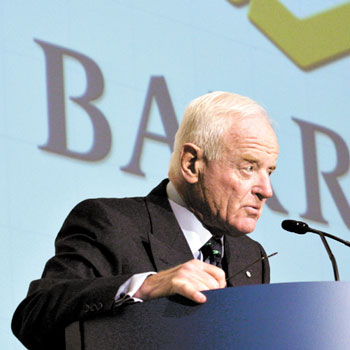
Environmental activists are up in arms after a Toronto-based mining company donated money to the Canadian Museum of Nature. Barrick Gold Corp. — founded by Forest Hill’s Peter Munk — was given naming rights to the museum’s salon, a prime reception area, in exchange for its $1 million contribution. The donation will also support refurbishing From Crystals to Gems, a popular exhibit.

Following the contribution, more than 20 organizations launched a campaign asking the museum to reconsider the gift, arguing, in a letter to CEO Meg Beckel, that accepting the money undermines the museum’s commitment to protecting the environment.

“We think it’s inconsistent with the nature museum’s mandate to promote the protection of nature to accept funds from a company with such a problematic environment track record,” said Ramsey Hart, Canada program co-ordinator of Ottawa-based MiningWatch Canada.

In an e-mail, Barrick Gold spokesperson Andy Lloyd responded: “In many ways, our success as a business depends on our ability to develop resources in a responsible way.” Lloyd also noted that Barrick Gold was approached by the museum for the funding.